Deng Chanyu
邓婵玉Teng Ch'an-yü · The Stone-Slinging Lady General
Daughter of the Marquis of Sanshan Pass, the Star of Six Harmonies
Deng Jiugong's daughter, a mortal general whose stones never miss a face. She wounded three Zhou champions and hit Kong Xuan three times when no immortal could touch him. Taken by a rope and married the same night to secure her father's defection, she fought for the Zhou until Gao Lanying blinded her with needles and cut her down. Enrolled as the Star of Six Harmonies.
The thrown stone, a mortal's skill against immortal arts, and a life decided by other people's bargain
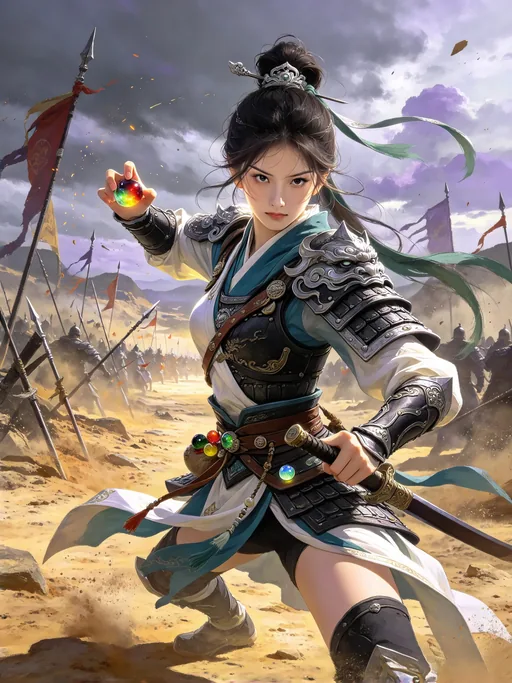
A General's Daughter, Nothing More
Deng Chanyu is the daughter of Deng Jiugong, the Marquis commanding Sanshan Pass, and the sister of Deng Xiu. Her mother died when she was small and her father raised her as his treasure. That is the whole of her pedigree: no teacher, no sect, no elixir. Everything she can do — the two swords, the horse, the stones — is household skill taught by a father in a garrison town.
This is rarer in the novel than it looks. Almost everyone who matters in the war is somebody's disciple. She is one of only two women who fight in the Zhou ranks, and unlike the other — Longji Gongzhu, daughter of a god — she is entirely mortal. No elixir, no disguise, no flight: if she is dismounted and surrounded she dies like anyone else, and she fights at the same disadvantage as the infantry being killed around her. The novel nonetheless gives her a full share of the glory without condescension: her weapons are described in the same technical register as anyone's, and her victories are won by aim, timing and nerve rather than by a greater power descending.
Two Swords and a Pouch of Stones
The novel describes her the way it describes beautiful women, and then immediately undercuts its own description by putting her on a horse with two swords out. The armour poem of the Mianchi chapters is the fullest picture: a gold helm flashing in the sun, a golden linked coat, a crimson padded jacket set against another fighter's white, two blades moving like lightning.
Her weapons are a matched pair of short swords, one in each hand, and a pouch of five-coloured stones — and the stones are the important half. They are small, they are thrown, they glow faintly, and they are aimed at the face, which means her victories are not kills but humiliations. Nezha, Huang Tianhua, Longxuhu: none is seriously hurt, all are marked, and a marked immortal on a battlefield is a general who has to be taken off it.
Three Stones
Her first day of fighting establishes the pattern. Her father has already been beaten and wounded by Nezha and is in his tent in pain; she asks for the assignment and goes out to avenge him. She loses the exchange of blades on purpose, turns her horse, and throws. The stone takes Nezha in the face. Huang Tianhua comes out and the stone takes him too. Longxuhu comes out and the stone takes him. Three generals of the Zhou vanguard in one sequence, none of them hurt in any way that matters, all driven off with their faces broken. The novel is clear that this is not magic overcoming magic: it is a woman with excellent aim.
The peak of her record comes much later, against an opponent nobody on the Zhou side can touch. Kong Xuan, whose five-coloured divine light takes treasure and weapon and man alike, is unassailable — Jiang Ziya cannot break him, Yang Jian cannot get near him. She hits him with a stone. Then again. Then a third time. It is not a victory; she cannot defeat him. But it is the only thing in that stretch of the campaign that lands on him at all, and the novel lets her have it.
The Night She Was Married
Then the ground opens. Tu Xing Sun binds her with the immortal-binding rope and carries her into the Zhou camp, and the camp does not treat her as a prisoner of war. It treats her as a contract. Deng Jiugong, in his cups on an earlier night, had promised his daughter to Tu Xing Sun if he could break the Zhou, and Jiang Ziya now holds three things at once — the promise, the daughter and the siege. He converts them into an alliance, and the wedding happens that same night.
The novel gives the bride one scene of resistance and makes it count. She tells Tu Xing Sun to his face that he sold his own master for favour, and his answer is the most brutal line in the episode: that whatever she is, nobody will believe it now. The novel then does not rescue her — it has her take the only lever left, her own marriage, and use it to argue her father into surrender. Made the price of the transaction, she becomes the one who closes it. This is worth stating plainly because it is usually softened: the novel does not present the marriage as a romance, and does not present her consent as given. What it presents is a competent woman handed a situation, making it work — and then being genuinely, durably loyal to the side she was handed to.
A Zhou General
What she does after the wedding is the part retellings most often skip. She becomes, quietly, one of the most useful people in the Zhou army.
She sees through Hong Jin's formation-gate escape and puts a stone in his face. She fights Gao Lanying for twenty exchanges and beats her, deliberately losing the sword fight as she did on her first day so that she can throw. Against immortals, demons and formations she is consistently the one who finds the seam: not the strongest, but the one whose method does not depend on being stronger. Her partnership with Tu Xing Sun becomes the camp's best combined-arms unit — she draws the eye and breaks the face, he comes up out of the ground behind whoever is looking at her.
The Needles, and the Six Harmonies
Tu Xing Sun is beheaded at Beast Crag, and the novel does not soften what happens to her next. She weeps, she asks for the assignment, she rides out to kill the man who killed him. It is the one decision in her story entirely her own, and it is the one that kills her. She meets Gao Lanying — the same opponent she has already beaten once — and Gao Lanying has learned the lesson: this time the gourd is in her hand and the needles are out before she even leaves the city. Deng Chanyu hears hooves, and her eyes are already gone. Blinded, on a horse, in the middle of a field, she is cut down where she sits.
The novel's epitaph for the pair is structural rather than stated: at Mianchi one husband-and-wife team kills another, art for art — needles for stones, faster earth-travel for slower. She is enrolled as the Star of Six Harmonies, an office concerned with pairing — marriages, the joining of families, the settling of disputes between states. It is the sharpest irony the roster produces, and the novel does not point at it: a woman whose own marriage was decided by a drunken promise, a capture and a commander's arithmetic is given charge of everyone else's. But she earned the entry — not as a disciple's wife or a general's daughter, but because she died in the field, on horseback, trying to kill the man who had killed her husband.
More from this collection
A Shang grand counselor and royal uncle of King Zhou, killed on Daji's demand for his seven-orifice heart. His death became one of the dynasty's defining crimes, and he was apotheosized as the Lord of the Wenqu Star.
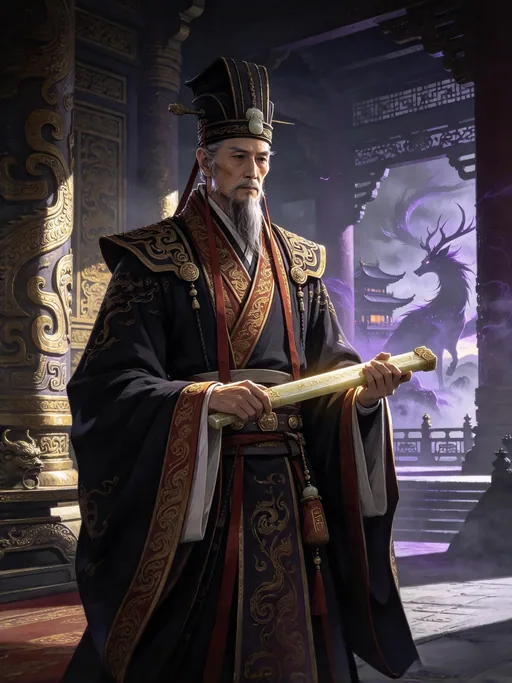
Bi Gan
MORTAL HEROES
比干
The youngest of the Sanxiao Sisters, a fiercely devoted and impulsive immortal who helped unleash the Nine-Meander Yellow River Formation, only to meet a tragic end at the hands of the supreme saints.
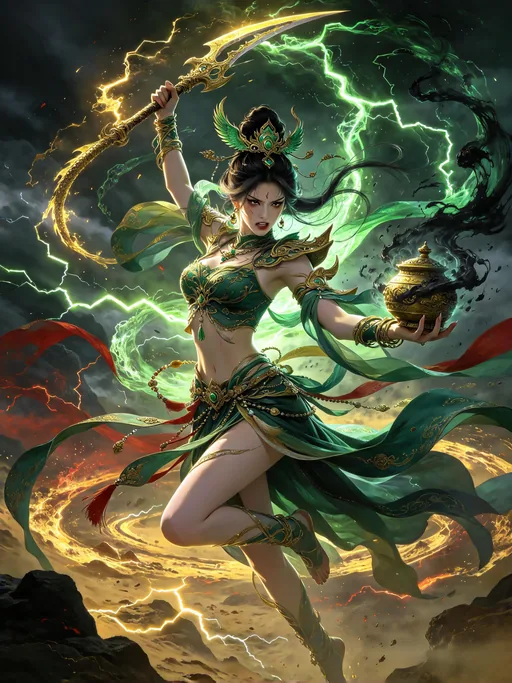
Bixiao Niangniang
IMMORTALS
碧霄娘娘
A beautiful maiden possessed by a thousand-year-old nine-tailed fox, sent by the goddess Nüwa to corrupt the Shang dynasty, only to be executed for her excessive cruelty.
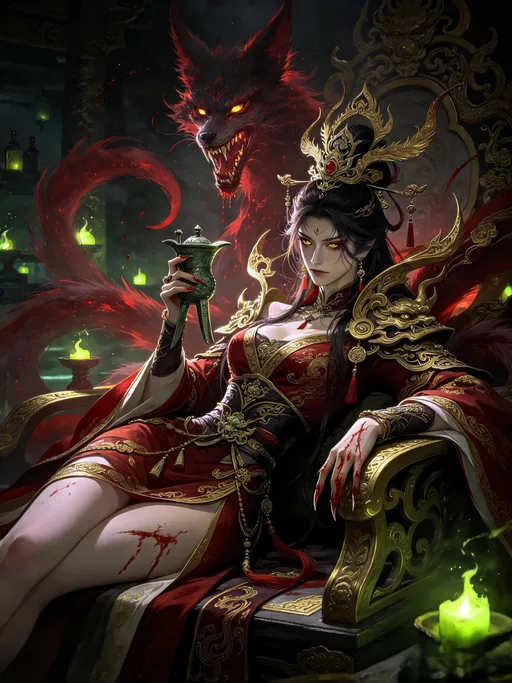
Da Ji
DEMONS
妲己
The powerful chief disciple of Tongtian Jiaozhu, whose arrogance sparked the final holy war, but whose defeat led to an unexpected apotheosis as the supreme Buddha of the West.
Duobao Daoren
IMMORTALS
多宝道人