Zhang Kui
张奎The Defender of Mianchi · The Earth-Walking General
Defender of Mianchi, the Seven-Slaughter Star
The Shang commander of Mianchi, master of an earth-travel that outran even Tu Xing Sun's, who with his wife killed the Five Peaks before being trapped underground by the Earth-Compelling Talisman and crushed by Wei Hu's pestle. Apotheosized as the Seven-Slaughter Star.
Loyal defense of a pass, earth-travel, and the office of the Seven-Slaughter Star
The Last Man Fighting for the Shang
Zhang Kui is the Shang commander of Mianchi County, the last major stronghold between the Zhou army and the capital. The novel introduces him very late, in Chapter 86, when the campaign has already broken the back of the Shang resistance and the fall of the dynasty is a matter of time. He is not a figure in the cosmic war between the Chan and Jie teachings. He is a mortal general, and his importance lies precisely there: he is the last man who fights for the Shang because he believes the Shang is worth fighting for.
His wife Gao Lanying fights beside him, and the novel treats them as a single martial unit. She wields a pair of sun-and-moon swords and carries a red gourd holding forty-nine sun-needles that fly out to pierce an opponent's eyes; he wields a long-handled great sword and rides a beast that can run a thousand li and travel through smoke. Between them they hold both the conventional and the supernatural means of war. The novel is also careful to establish that he is not a villain: he does not torture, does not betray, does not defect. He defends a pass entrusted to him, with a competence the Zhou side finds genuinely hard to answer, and the novel respects that loyalty even while arranging his defeat.
A Beast and a Technique
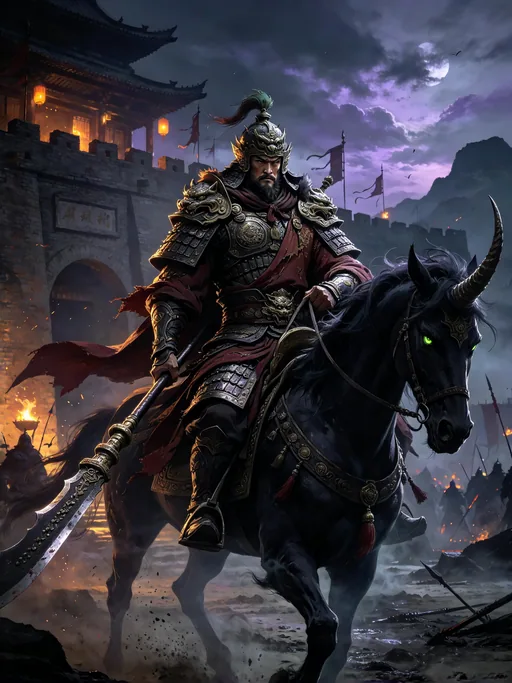
His visual identity is that of the mature Shang field commander: heavy-set, broad-shouldered, short-bearded, with the weathered face of a man who has spent his life on a frontier. He wears the layered dark-iron armour of a Shang general and carries a long-handled great sword — a weapon for someone who fights from the saddle and relies on weight and reach.
His mount is the Single-Horned Black Smoke Beast, whose hooves leave trails of black smoke and whose pace gives him a mobility ordinary cavalry cannot match. It is also, in the novel's cruellest joke, the first thing he loses: deceived by Yang Jian's illusions, he orders his own beast beheaded in the belief that he is executing his enemy. His second and less visible power is earth-travel — moving through the ground as though it were water, fifteen hundred li a day. That is what makes him genuinely dangerous, since it lets him appear behind an enemy line without warning, and in the novel's arithmetic it is five hundred li a day faster than the earth-travel of Tu Xing Sun, the one specialist in the Zhou camp who can follow him underground.
Nine Killings at Mianchi
His defining episode is a sequence of duels and ambushes in which he and his wife destroy the Zhou army's senior commanders one after another, each engagement using a different mix of his abilities and her needles.
The first to fall are two of King Wu's younger brothers, killed in the opening exchanges. Then comes the engagement the chapter is named for, in which the Five Peaks — Huang Feihu, Chong Heihu, Wen Pin, Cui Ying and Jiang Xiong, lords who have fought through the whole campaign — surround him together. He holds them all; when the others pull back to let Chong Heihu loose his iron-beaked eagle, the Black Smoke Beast's speed carries Zhang Kui in among them first, and Wen Pin and Chong Heihu die. Then Gao Lanying rides out, releases the needles and blinds the remaining three, and Zhang Kui cuts Huang Feihu, Cui Ying and Jiang Xiong down where they sit. Huang Feihu's younger brother follows. Then the earth-traveler: Tu Xing Sun goes to Mount Jialong to fetch the technique that will counter him, and Zhang Kui, warned in advance, earth-travels to Beast Crag and waits, and takes the head with one stroke as it breaks the surface. Tu Xing Sun's widow rides out to avenge him and dies to the same needles. Nine kills in all, five of them lords, one of them the only man in the Zhou camp who could match him underground.
The Breaking of Mianchi
The Zhou side cannot take Mianchi by conventional assault, and cannot reach him underground. So it turns to cunning. Yang Jian allows himself to be captured twice and escapes by substitution each time, so that Zhang Kui's executioners behead his own beast, and then his own aged mother, believing they are killing the enemy. The novel gives this trick no moral gloss: it is cruelty used as a weapon, and it leaves him shaken and raging.
The counter to earth-travel finally comes from above the ground. Ju Liusun sends the Earth-Compelling Talisman — a charm that turns the ground to steel and pins an earth-traveler inside it. Jiang Ziya uses King Wu himself as bait to draw Zhang Kui out, and when Zhang Kui dives into the earth Yang Jian burns the talisman; the ground closes on him like a mould. Unable to move, unable to flee, he is struck by Wei Hu's pestle and reduced to powder. Mianchi falls in the same assault: Gao Lanying holds Nezha on the wall with her two swords, then rides down to get room for the gourd, and before she can open it the universe-ring takes her on the crown and a spear finishes her. The road to the capital is open, and the war's end becomes a matter of chapters rather than campaigns.
The Seven-Slaughter Star
After the war Jiang Ziya enrolls him among the 365 gods as the Seven-Slaughter Star, one of the stars of the Dipper and one of the most feared offices in Chinese astrological religion. It governs slaughter, execution and violent death; in astrological practice it marks a destiny that brings conflict and, in some readings, greatness through conflict. Gao Lanying is enrolled as the Peach-Blossom Star — a pairing later folk divination reads with some irony, the star of killing and the star of love bound in one marriage.
The appointment is an exact match between man and office: a soldier who killed nine commanders in defence of a doomed pass becomes the star of killing. The novel does not soften it, and does not present the apotheosis as a reward for virtue or a consolation for defeat — it presents it as the cosmos assigning an office to a power the world needs to have governed. That is consistent with the system's logic: gods are not made from the virtuous alone but from the powers the war has concentrated and the cosmos must then stabilise. Zhang Kui concentrated the power of killing at Mianchi, and the Seven-Slaughter Star is where that concentration is stored.
A Soldier, Not an Immortal
In the novel he is a useful counterweight to the idea that this is a story about immortals. He has no teacher, no elixir, no treasure in the ordinary sense: he has a sword, a beast, a wife and a technique, and with those he kills nine commanders, five of them lords, in a war that has spent eighty chapters defeating supernatural enemies. His presence is a reminder that this is also a war fought by soldiers, and that some of those soldiers are extremely good at their job.
He is also, quietly, one of the novel's most uncomfortable demonstrations of how the Zhou side wins. Bringing down one mortal garrison commander takes a substitution trick that kills his mount and his mother, a charm borrowed from an immortal's master, King Wu used as bait, and the combined efforts of Yang Jian, Wei Hu and Nezha. The novel never says so outright, but the arithmetic of that final operation is its own comment — and so is his office. The star of slaughter is not a reward. It is the register's way of naming what a man was, and filing it.
More from this collection
A Shang grand counselor and royal uncle of King Zhou, killed on Daji's demand for his seven-orifice heart. His death became one of the dynasty's defining crimes, and he was apotheosized as the Lord of the Wenqu Star.
Bi Gan
MORTAL HEROES
比干
The youngest of the Sanxiao Sisters, a fiercely devoted and impulsive immortal who helped unleash the Nine-Meander Yellow River Formation, only to meet a tragic end at the hands of the supreme saints.
Bixiao Niangniang
IMMORTALS
碧霄娘娘
A beautiful maiden possessed by a thousand-year-old nine-tailed fox, sent by the goddess Nüwa to corrupt the Shang dynasty, only to be executed for her excessive cruelty.
Da Ji
DEMONS
妲己
Deng Jiugong's daughter, a mortal general whose stones never miss a face. She wounded three Zhou champions and hit Kong Xuan three times when no immortal could touch him. Taken by a rope and married the same night to secure her father's defection, she fought for the Zhou until Gao Lanying blinded her with needles and cut her down. Enrolled as the Star of Six Harmonies.

Deng Chanyu
MORTAL HEROES
邓婵玉