Nezha
哪吒Third Lotus Prince · Nezha San Taizi
Third Lotus Prince
A lotus-born deity known for his rebellion against authority and his role in the Investiture of the Gods.
Protector of children and travelers
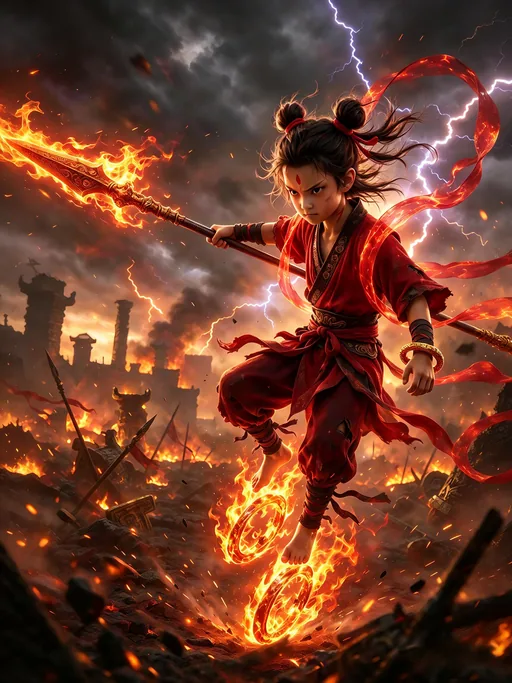
Identity and Origins
Nezha is not born in the ordinary sense. He is the reincarnation of the Lingzhu Pearl, a treasure entrusted to the immortal Taiyi Zhenren. Taiyi arranges for the pearl to be born to Lady Yin, wife of the garrison commander Li Jing, as a reward for her piety. She carries the child for three years and six months. When she finally gives birth, it is not a baby but a fleshy sphere that rolls across the floor. Li Jing, believing it to be a curse, splits it open with his sword. Inside stands a boy already able to walk and speak.
This birth scene sets the tone for everything that follows: Nezha enters the world through violence, and his relationship with his father begins in suspicion rather than love.
Appearance and Iconography
In his classical form, Nezha is a youthful figure, often depicted as a boy or young man with a fierce expression. His most recognizable feature is his ability to manifest three heads and six arms, each hand holding a different weapon. He rides on wind-and-fire wheels — a pair of flaming discs beneath his feet that carry him through the air faster than any horse.
His primary weapons are the Universe Ring, a golden bracelet that can expand and strike with devastating force; the Red Armillary Sash, a length of silk that binds and entangles; and a fire-tipped spear. These objects are not decorative. Each one appears in specific episodes of the Investiture narrative, and each one becomes a visual shorthand for Nezha in later art, opera, and film.
The Dragon King's Son
The episode that defines Nezha's early life begins on a hot day by the river. Nezha, playing in the water, uses the Red Armillary Sash, which stirs up the Eastern Sea and shakes the Dragon King's palace. The Dragon King sends his third son, Ao Bing, to investigate. Ao Bing confronts Nezha, and the encounter escalates quickly. Nezha kills Ao Bing, then returns home and, to prove his lack of fear, extracts the dragon's sinews to make a belt for his father. This detail matters: Nezha is not merely violent, he is performatively defiant. He wants his father to see what he has done.
When the Dragon King comes to demand justice, Nezha does not hide. He offers his own body to settle the debt — he strips the flesh from his bones and returns it to his mother, and returns his bones to his father. This act, known as 'returning the flesh and bones' (tigu huanfu, 剔骨还父), is the emotional core of the Nezha story. In Chinese cultural terms, it is a radical severing of the debt of filial piety. He is saying: I owe you nothing, not even this body.
Death, Lotus Rebirth, and the Investiture War
After the flesh-and-bone act, Nezha is, in effect, dead. His mother builds a shrine to him, but Li Jing destroys it, fearing the shame. Nezha's spirit drifts until Taiyi Zhenren intervenes. Taiyi gathers lotus roots, leaves, and flowers and reassembles Nezha's body from them. The reborn Nezha is not a child anymore — he is a divine warrior, purified of mortal debt, and he now has a new purpose. This is where the Investiture of the Gods narrative picks him up. Jiang Ziya, leading the Zhou campaign against the Shang, needs warriors who are not bound by ordinary mortality. Nezha joins the Zhou army as a vanguard.
His first act as a reborn warrior is to pursue Li Jing, intending to kill him. Taiyi intervenes, giving Li Jing a magical tower (the Linglong Pagoda) that can trap Nezha, and the two are forced into an uneasy reconciliation. From this point, Nezha fights through the major campaigns of the war: breaking the Ten Absolute Formations, battling the Jie faction immortals, and repeatedly turning the tide for the Zhou side. His role in the war is not that of a strategist — that is Jiang Ziya and Yang Jian — but of a shock trooper, the one sent to break through when conventional force fails.
Fate and Apotheosis
Nezha survives the Investiture War. Unlike many of the characters in the story, he is not killed and then enrolled among the 365 gods of the Fengshen roster. Instead, he achieves what the text calls 'physical apotheosis' (roushen chengsheng, 肉身成圣) — he ascends as a god in his own body, without passing through death. His formal title in later tradition is the Third Lotus Prince, and he is worshipped as a protector of children, travelers, and those in danger.
This outcome is significant: in the logic of the Investiture, most gods are made through death and judgment. Nezha is one of the few who becomes divine without that final judgment, because his death and rebirth already happened earlier, in the lotus.
Cultural Legacy
Nezha's story has been retold continuously for centuries. In Journey to the West, he appears as a celestial general who fights Sun Wukong and later aids the pilgrims. In folk religion, he is a popular deity with temples across Taiwan, Fujian, and Southeast Asia. In modern culture, he is the subject of the highest-grossing animated film in Chinese history, Ne Zha (2019), which reimagines his conflict with Ao Bing as a friendship torn apart by fate.
What makes Nezha endure is the tension at his core: he is a figure of violent rebellion who is also, in the end, a protector. He defies his father, defies the Dragon King, defies the order of the world, and then becomes one of the gods who upholds that order. That contradiction is why he remains compelling.
More from this collection
A Shang grand counselor and royal uncle of King Zhou, killed on Daji's demand for his seven-orifice heart. His death became one of the dynasty's defining crimes, and he was apotheosized as the Lord of the Wenqu Star.
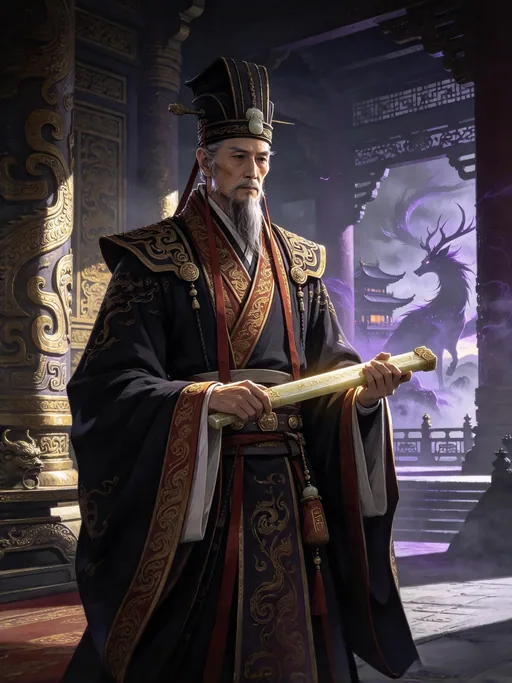
Bi Gan
MORTAL HEROES
比干
The youngest of the Sanxiao Sisters, a fiercely devoted and impulsive immortal who helped unleash the Nine-Meander Yellow River Formation, only to meet a tragic end at the hands of the supreme saints.
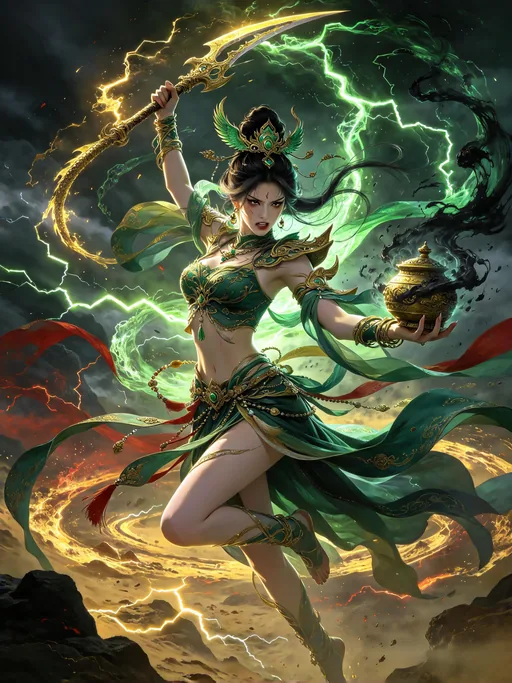
Bixiao Niangniang
IMMORTALS
碧霄娘娘
A beautiful maiden possessed by a thousand-year-old nine-tailed fox, sent by the goddess Nüwa to corrupt the Shang dynasty, only to be executed for her excessive cruelty.
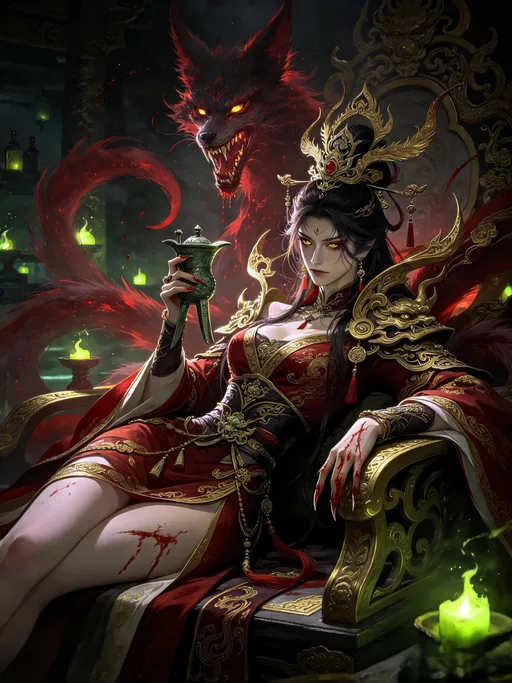
Da Ji
DEMONS
妲己
Deng Jiugong's daughter, a mortal general whose stones never miss a face. She wounded three Zhou champions and hit Kong Xuan three times when no immortal could touch him. Taken by a rope and married the same night to secure her father's defection, she fought for the Zhou until Gao Lanying blinded her with needles and cut her down. Enrolled as the Star of Six Harmonies.
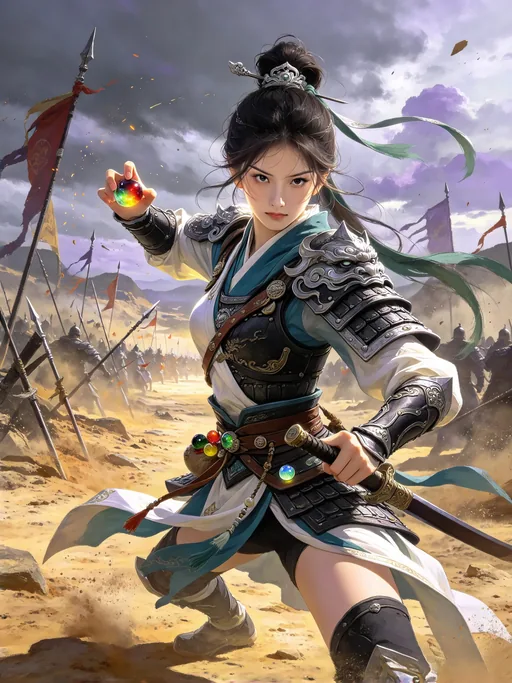
Deng Chanyu
MORTAL HEROES
邓婵玉