Jie Yin Daoren
接引道人The Guide · Teacher of the Western Heaven
Great Lord of the Western Teaching
The senior lord of the Western Teaching, who entered the Investiture War as an ally of the Chan faction and departed with three thousand of the Jie faction's immortals gathered into his Qiankun Bag.
Salvation and guidance of souls to the Western Pure Land
Identity and Origins
Jie Yin Daoren is the senior of the two lords of the Western Teaching (西方教), the elder brother in the dharma to Zhunti Daoren. The novel introduces him late, in Chapter 65, but his authority is never in question: he is a figure of the same order as Laozi and Yuanshi Tianzun, a "Great Enlightened Golden Immortal" (大觉金仙) whose residence lies in the Western Pure Land, far from the political and military struggles of the Central Plains.
His name is a theological statement. "Jie Yin" means "to receive and guide" — the act by which Amitābha Buddha welcomes the faithful into the Western Pure Land at the end of their lives. The novel does not invent this figure from nothing; it takes the most recognizable soteriological gesture in Chinese Buddhist devotion and places it inside a Daoist cosmic war. Jie Yin Daoren is, in effect, Amitābha in Daoist robes: a being whose power is not conquest but reception.
This origin matters for how he behaves in the narrative. He does not enter the war to defeat the Shang or to punish the Jie faction. He enters because the war has produced a surplus of immortal souls, and the Western Teaching has the capacity — and the mandate — to gather them.
Appearance and Iconography
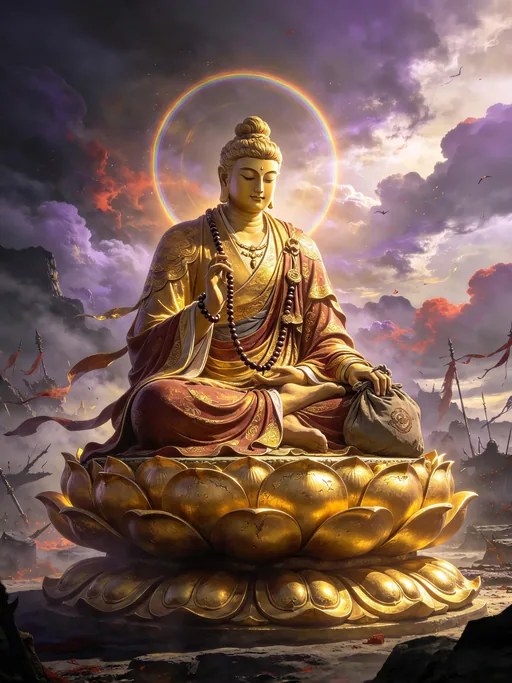
The novel gives Jie Yin a spare but unmistakable physical description: a golden body sixteen feet tall, a yellow complexion, and hair gathered into a topknot (抓髻). He is usually seated on the Twelve-Petaled Golden Lotus Throne (十二品莲台), the ritual treasure that anchors the Western Teaching's cosmic fortune, and he carries a string of prayer beads.
His iconography is deliberately minimal compared with the martial clutter of the Fengshen cast. He has no armor, no halberd, no mount. The lotus is his seat, not his weapon; the beads are for recitation, not for striking. The one object in his possession that functions as an instrument of war is the Qiankun Bag (乾坤袋), a sack that can receive and contain living beings without violence. When he does act decisively in battle, the action is always one of drawing something in, never cutting something down.
This restraint is visual as much as doctrinal. In a war of banners, blades, and formations, Jie Yin Daoren's silhouette is that of a seated figure surrounded by light — a still center in a field of motion.
The Twelve-Petaled Lotus and the Mosquito Daoist
The most revealing episode in Jie Yin's Fengshen career is not a victory. It is a loss of three lotus petals.
During the campaign, Jie Yin subdues the Jie faction immortal Guiling Shengmu (龟灵圣母), who had defeated the Chan disciple Juxian Sun with the Sun-Moon Pearl. He dispatches his attendant, the White Lotus Boy, to take her into custody. But the bag the boy carries is mishandled, and a swarm of mosquitoes escapes — among them the Mosquito Daoist (蚊道人). The swarm drains Guiling Shengmu's flesh and blood, killing her, and then fastens onto Jie Yin's own Twelve-Petaled Lotus Throne, consuming three of its twelve petals. The throne is permanently diminished to nine petals.
This episode is often read as a minor embarrassment, but it does structural work in the novel's cosmology. Jie Yin's power is not untouchable, and the Western Teaching's treasure is not immune to contingency. The lord who can gather three thousand immortals into a bag cannot prevent a small oversight from costing him a quarter of his throne. The Fengshen world is one in which even the highest beings are subject to the ripple effects of action, and Jie Yin's serenity is not invulnerability — it is composure in the face of irreversible loss.
The Qiankun Bag and the Harvest of Ten Thousand Immortals
Jie Yin's decisive contribution comes at the Ten Thousand Immortals Formation (万仙阵), the final and largest confrontation of the war. He fights alongside Laozi, Yuanshi Tianzun, and his junior Zhunti Daoren. His role, however, is not to break the formation by force. When the formation falls, he opens the Qiankun Bag and receives into it three thousand of the Jie faction's immortals — practitioners who, in the novel's language, "have a affinity with the West" (与西方有缘).
The scale is the point. The Fengshen roster itself contains only 365 positions. Jie Yin departs with nearly ten times that number. He does not kill them; he relocates them. The Western Teaching begins the war as a distant, marginal tradition and ends it as the custodian of a vast population of trained immortals. This is the novel's most consequential transfer of human — or rather, immortal — capital, and it is accomplished with a bag, not a blade.
After the formation is broken, Jie Yin also receives the Jie immortal Dingguang Xian, who had fled the battlefield, and then returns west with his gathered charges. He does not linger to claim territory, title, or tribute. The war was, for him, a recruitment.
Fate and Apotheosis
Jie Yin Daoren does not appear on the Fengshen roster. He is not killed, judged, and enrolled among the 365 gods. He is already a Great Enlightened Golden Immortal before the war begins, and when the war ends he simply returns to the Western Pure Land with his gathered immortals.
This outcome is structurally distinct from Nezha's "physical apotheosis." Nezha achieves divinity through death and lotus rebirth within the narrative. Jie Yin begins outside the narrative's economy of death and judgment altogether. He is not a god made by the Investiture; he is a cosmic figure who participates in the Investiture without being subject to its machinery. The war changes the balance of power between East and West, but it does not change his status.
In later reception, Jie Yin Daoren is identified with the Jie Yin Buddha (接引佛祖) of Journey to the West, the ferryman who takes the pilgrims across the Lingyun Ferry in a bottomless boat. The "receiving and guiding" that was his name becomes, in the later text, a literal act of ferrying — one final modulation of a figure whose entire narrative function is to carry beings from one shore to another.
Cultural Legacy
Jie Yin Daoren's legacy is inseparable from the larger question of how the Fengshen Yanyi relates to Buddhism. He is the novel's most explicit bridge between the Daoist pantheon and the Buddhist one: a figure who bears a Daoist title, operates within a Daoist cosmic war, and is recognizable at every turn as Amitābha, the central object of Pure Land devotion in Ming China.
This makes him a useful case study in the novel's religious imagination. The Fengshen Yanyi was composed in a milieu where Buddhist and Daoist vocabularies were deeply interpenetrated. Jie Yin does not represent a "Buddhist intrusion" into a "Daoist story." He represents the ordinary condition of late-imperial Chinese religion, in which a single narrative could hold Laozi, Yuanshi Tianzun, and the Buddha of Infinite Light without any felt contradiction.
For a contemporary English-language readership, Jie Yin also offers a counterweight to the martial heroes who dominate the Fengshen cast. He is powerful, but his power is expressed through reception rather than destruction. The Qiankun Bag is a weapon that only works by taking living beings in — not by cutting them apart. In a story about a war that produces gods through death, Jie Yin is the one major figure whose signature act is to gather the living and carry them somewhere else.
More from this collection
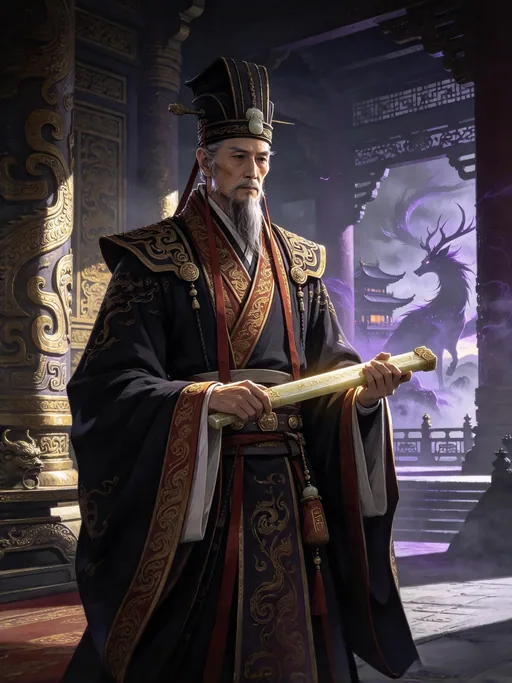
A Shang grand counselor and royal uncle of King Zhou, killed on Daji's demand for his seven-orifice heart. His death became one of the dynasty's defining crimes, and he was apotheosized as the Lord of the Wenqu Star.
Bi Gan
MORTAL HEROES
比干
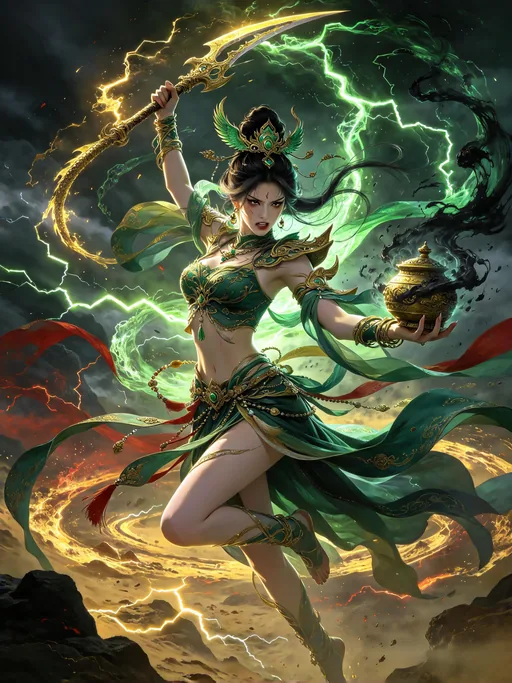
The youngest of the Sanxiao Sisters, a fiercely devoted and impulsive immortal who helped unleash the Nine-Meander Yellow River Formation, only to meet a tragic end at the hands of the supreme saints.
Bixiao Niangniang
IMMORTALS
碧霄娘娘
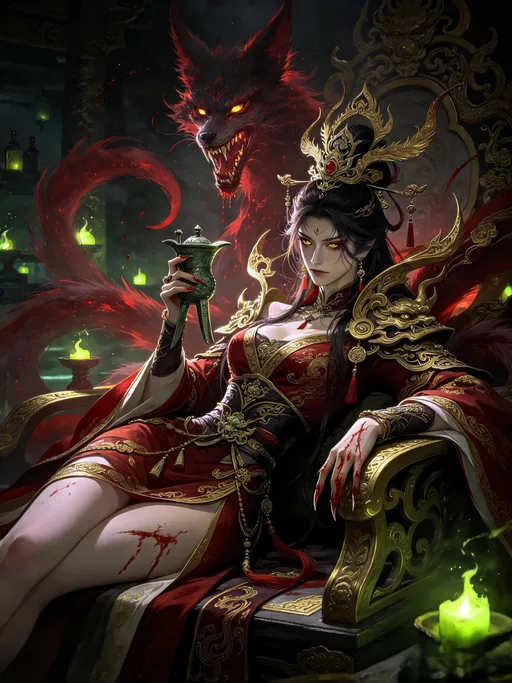
A beautiful maiden possessed by a thousand-year-old nine-tailed fox, sent by the goddess Nüwa to corrupt the Shang dynasty, only to be executed for her excessive cruelty.
Da Ji
DEMONS
妲己
Deng Jiugong's daughter, a mortal general whose stones never miss a face. She wounded three Zhou champions and hit Kong Xuan three times when no immortal could touch him. Taken by a rope and married the same night to secure her father's defection, she fought for the Zhou until Gao Lanying blinded her with needles and cut her down. Enrolled as the Star of Six Harmonies.
Deng Chanyu
MORTAL HEROES
邓婵玉