Li Jing
李靖Pagoda-Bearing Heavenly King
Pagoda-Bearing Heavenly King
A mortal general who became a celestial king, defined by his fraught relationship with his son Nezha and his iconic pagoda.
Commander of the Celestial Armies
Identity and Origins
Before he became a god, Li Jing was the commander of Chen Tang Pass (Chentangguan) during the Shang dynasty. He was a strict, disciplined, and highly traditional military leader, loyal to the emperor and the established order. However, his life was thrown into chaos by the birth of his third son, Nezha.
Li Jing is often seen as a complicated, even tragic figure. He is bound by the rigid laws of mortal society and heavenly decrees, which puts him in direct conflict with Nezha, who represents absolute freedom and rebellion.
Appearance and Iconography
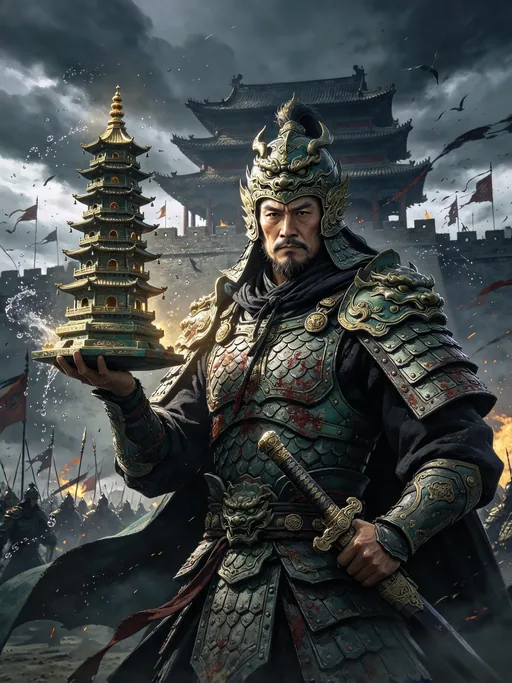
Li Jing is depicted as a middle-aged, stern-faced general with a neatly trimmed beard and heavy, furrowed brows that reflect a lifetime of military discipline and deep anxiety. He wears heavy bronze and iron scale armor, often with a beast-faced helmet.
His most defining artifact is the Linglong Pagoda (the Exquisite Pagoda), a glowing bronze tower he holds in one hand. This pagoda was given to him by the immortal Randeng Daoren specifically to suppress Nezha. If Nezha ever attacks him in a rage, Li Jing only needs to raise the pagoda to trap his son inside and burn him with divine fire. The pagoda is thus a dual symbol: it is his divine weapon, but it is also a symbol of a father who can only control his son through overwhelming force.
The Conflict with Nezha
The core of Li Jing's story is his tragedy as a father. When Nezha was born as a fleshy sphere, Li Jing's first instinct was to split it open, an act of fear that began their estrangement. Later, after Nezha killed the Dragon King's son and provoked a flood that threatened the entire pass, Li Jing's priority was to save his people and preserve his duty, even if it meant sacrificing Nezha.
After Nezha's suicide and subsequent lotus rebirth, Nezha sought revenge against Li Jing for destroying his shrine and for his coldness. Li Jing was forced to rely on the pagoda given by Randeng Daoren to survive his son's wrath. Ultimately, under the mediation of immortals, they "reconciled," but their relationship was never warm—it was merely a ceasefire brokered by higher powers.
The Investiture War
Following the events with Nezha, Li Jing eventually abandoned the Shang dynasty and defected to King Wu of Zhou, joining Jiang Ziya's campaign. As a veteran commander, he was crucial in leading troops and coordinating military formations.
During the Investiture War, he fought alongside his sons, including Nezha, though their interactions remained formal and military. His experience and leadership were highly valued by Jiang Ziya, and he survived the war to receive his divine appointment.
Fate and Apotheosis
Unlike his son Nezha, who achieved physical apotheosis, Li Jing's ascension to godhood is tied to his duty. After the war, he is enrolled on the Investiture Roster and appointed as the Pagoda-Bearing Heavenly King.
In heaven, he commands the celestial armies and is the direct subordinate of the Jade Emperor. His family—himself, his wife Lady Yin, and his three sons—are all elevated to divine status, a rare honor that reflects the absolute vindication of his disciplined, if rigid, way of life.
Cultural Legacy
Li Jing represents the archetype of the traditional patriarch: strict, duty-bound, and sometimes emotionally distant, but ultimately a protector of order. In Chinese iconography, he is always depicted holding the pagoda, reminding the viewer of the eternal tension between authority and youthful rebellion.
In modern retellings, such as the 2019 animated film *Ne Zha*, Li Jing's character has been humanized significantly. Instead of the cold, fear-driven father of the classic texts, modern adaptations often portray him as a loving father who is willing to sacrifice everything for his son, reflecting a shift in how modern audiences view paternal authority.
More from this collection
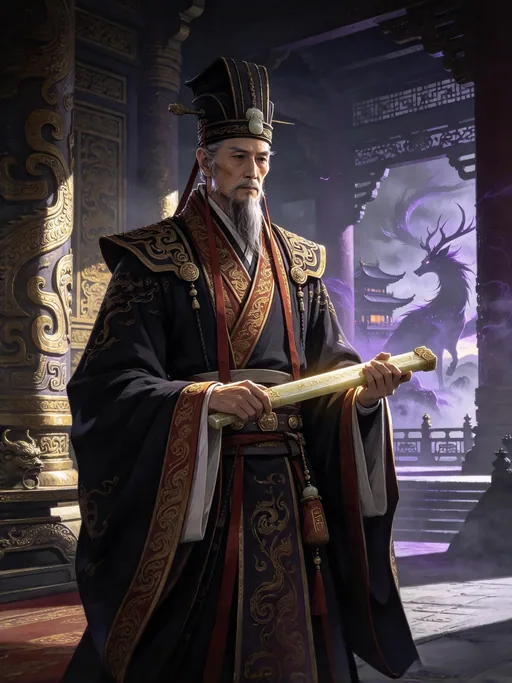
A Shang grand counselor and royal uncle of King Zhou, killed on Daji's demand for his seven-orifice heart. His death became one of the dynasty's defining crimes, and he was apotheosized as the Lord of the Wenqu Star.
Bi Gan
MORTAL HEROES
比干
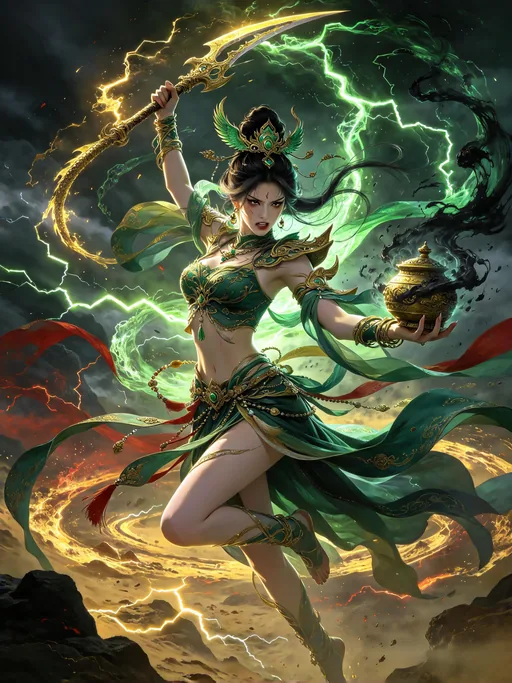
The youngest of the Sanxiao Sisters, a fiercely devoted and impulsive immortal who helped unleash the Nine-Meander Yellow River Formation, only to meet a tragic end at the hands of the supreme saints.
Bixiao Niangniang
IMMORTALS
碧霄娘娘
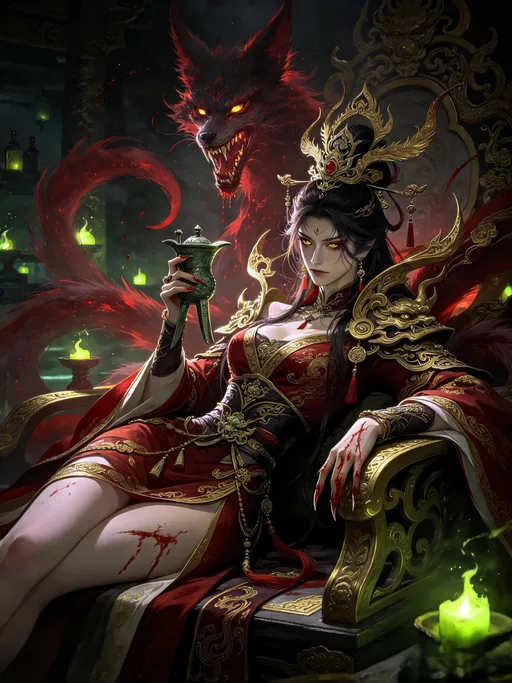
A beautiful maiden possessed by a thousand-year-old nine-tailed fox, sent by the goddess Nüwa to corrupt the Shang dynasty, only to be executed for her excessive cruelty.
Da Ji
DEMONS
妲己
Deng Jiugong's daughter, a mortal general whose stones never miss a face. She wounded three Zhou champions and hit Kong Xuan three times when no immortal could touch him. Taken by a rope and married the same night to secure her father's defection, she fought for the Zhou until Gao Lanying blinded her with needles and cut her down. Enrolled as the Star of Six Harmonies.
Deng Chanyu
MORTAL HEROES
邓婵玉