Jiang Ziya
姜子牙Jiang Taigong · Tai Gong Wang
Tai Gong Wang, the Grand Duke of the West
An aged immortal strategist who descended from the mountains to overthrow a tyrant, ultimately becoming the divine judge who appointed the gods of the new cosmos.
God of Strategy, Enforcer of the Investiture Roster
Identity and Origins
Jiang Ziya is one of the most unique figures in Chinese mythology because he is a hero defined by his lack of divine talent. He spent forty years studying Daoist arts under the Supreme Deity Yuanshi Tianzun at Kunlun Mountain. However, Yuanshi Tianzun eventually declared that Jiang Ziya was destined to fail at achieving true immortality. His fate lay in the mortal realm, where he was to experience earthly suffering and, ultimately, become the instrument of heaven's will.
At the age of seventy-two, he descended the mountain. He failed at several mundane businesses and ended up fishing by the Wei River with a bizarre method: a straight hook, no bait, and held above the water. This was not madness, but a calculated wait. He was waiting for King Wen of Zhou, who eventually arrived, recognized the old man's wisdom, and invited him to become the chief strategist for the rebellion against the Shang dynasty.
Appearance and Iconography
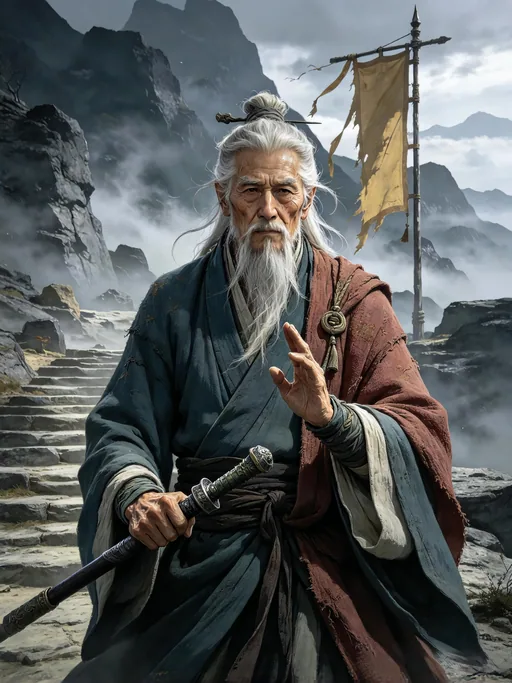
Jiang Ziya is not depicted as a muscular warrior or a glowing youth, but as a frail, deeply wrinkled old man with a long white beard. He wears simple, worn Daoist robes of rough hemp, reflecting his decades of hardship.
His most important artifact is the Deity-Beating Whip (Dashen Bian), a black iron rod engraved with sacred talismans. This weapon is unique because it cannot harm mortals or ordinary demons; it only inflicts pain on those whose names are already written on the Investiture Roster. He also carries the Central Apricot Yellow Flag, a supreme defensive treasure that can block almost any magical attack. His mount is the Si Bu Xiang (the "Four-Unlike Beast"), a chimera with the antlers of a deer, the tail of a cow, the hooves of a horse, and the face of a donkey.
The Investiture War
Jiang Ziya commands the Zhou army, but his role is not to fight on the front lines. He is the commander, the strategist, and the bureaucrat. Time and again, when the Zhou forces are pushed to the brink of annihilation by the powerful immortals of the Jie faction, Jiang Ziya is the one who coordinates the defense, deploys the banners, and calls upon his far more powerful allies like Yang Jian and Nezha.
Throughout the war, he endures immense humiliation and hardship. He is killed multiple times by deadly formations (such as the Ten Absolute Formations and the Nine-Meander Yellow River Formation) and must be resurrected by his allies using magical pills. His journey is not one of glorious triumph, but of relentless survival and duty.
Fate and Apotheosis
The climax of Jiang Ziya's life is the Investiture of the Gods. Standing before the altar, holding the Jade Register, he reads out the names of the 365 individuals—both his allies and his enemies—who died in the war, assigning them their eternal divine domains. He is the ultimate judge, yet he holds a tragic position: he is the only one who cannot become a god himself.
Because he holds the roster, he is ineligible to be on it. After completing his task, he is sent back to the mortal world. He is granted the fiefdom of Qi (modern-day Shandong) and rules there for decades as a mortal lord, bringing peace and prosperity to his people.
Cultural Legacy
Jiang Ziya is revered as the ancestor of Chinese military strategy. His famous fishing method—"Jiang Taigong fishes, the willing takes the bait" (Jiang Taigong diaoyu, yuanzhe shang gou)—is a common idiom in China, meaning that one should wait patiently for the right opportunity, or that a true ruler will naturally attract loyal talent.
In folk beliefs, he is also considered a powerful apotropaic figure. It was said that after he finished assigning all the divine positions, there was no spot left for himself, so he chose the roof of every house. This is why traditional Chinese homes often bear the inscription "Tai Gong is here, all is well" (Taigong zaici, baibuwujinji) to ward off evil spirits.
More from this collection
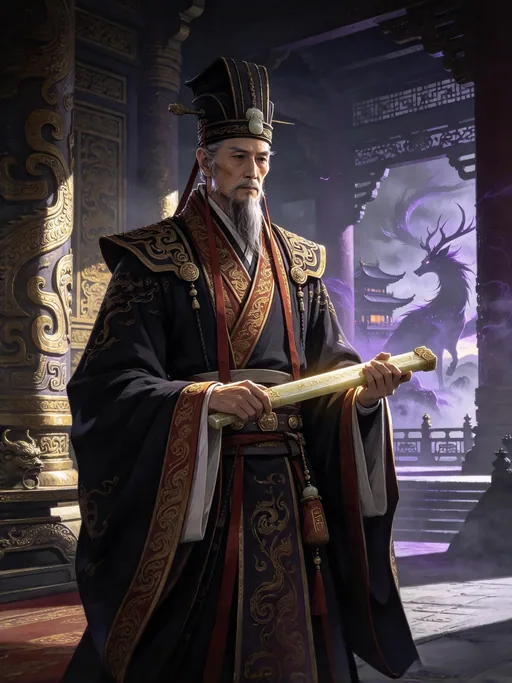
A Shang grand counselor and royal uncle of King Zhou, killed on Daji's demand for his seven-orifice heart. His death became one of the dynasty's defining crimes, and he was apotheosized as the Lord of the Wenqu Star.
Bi Gan
MORTAL HEROES
比干
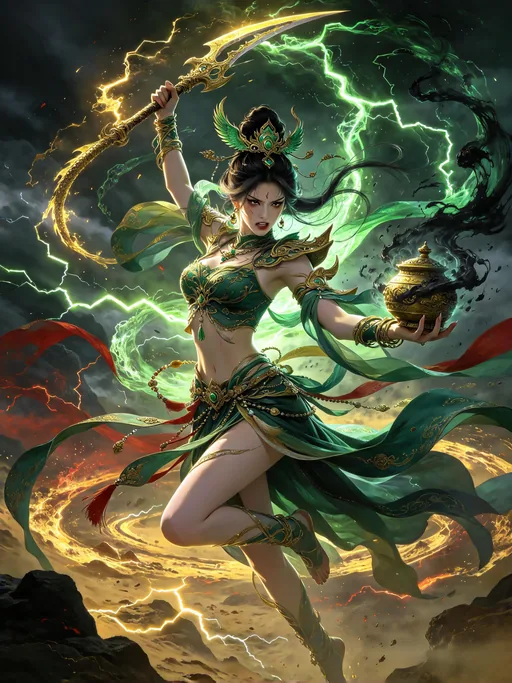
The youngest of the Sanxiao Sisters, a fiercely devoted and impulsive immortal who helped unleash the Nine-Meander Yellow River Formation, only to meet a tragic end at the hands of the supreme saints.
Bixiao Niangniang
IMMORTALS
碧霄娘娘
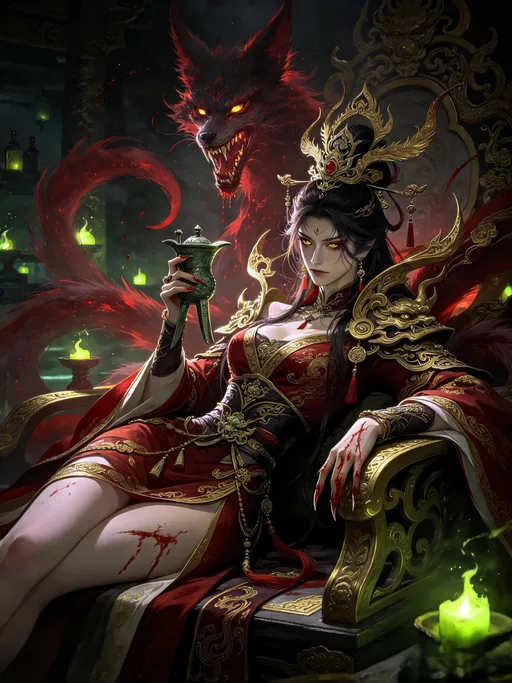
A beautiful maiden possessed by a thousand-year-old nine-tailed fox, sent by the goddess Nüwa to corrupt the Shang dynasty, only to be executed for her excessive cruelty.
Da Ji
DEMONS
妲己
Deng Jiugong's daughter, a mortal general whose stones never miss a face. She wounded three Zhou champions and hit Kong Xuan three times when no immortal could touch him. Taken by a rope and married the same night to secure her father's defection, she fought for the Zhou until Gao Lanying blinded her with needles and cut her down. Enrolled as the Star of Six Harmonies.

Deng Chanyu
MORTAL HEROES
邓婵玉