Lu Ya
陆压Lu Ya Daoren · The Immortal of Western Kunlun
The Wandering Immortal of Western Kunlun
A mysterious, unaffiliated immortal who intervened in the war on the side of Zhou, using dark sorcery and a magical gourd to assassinate immortals whose powers were otherwise unmatched.
Primordial Fire, Curses, and Absolute Execution
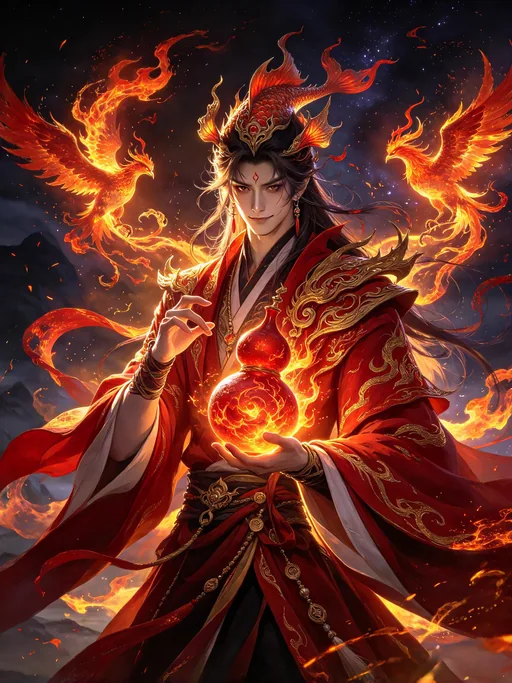
Identity and Origins
Lu Ya is the ultimate wildcard of the Investiture of the Gods. He introduces himself as a carefree hermit from Western Kunlun, answering to no master—not even the supreme saints of the Chan or Jie factions.
The novel only describes him as "the treasure within fire, the essence of earth, the spirit of samadhi fire," strongly implying a primordial fire origin. Later folklore and modern novels often identify him as a remnant of the Three-Legged Golden Crow (the sun bird), but this is a later interpretation, not stated in the original novel. Either way, it explains his immunity to fire magic and his ancient, detached aura.
Appearance and Iconography
Lu Ya is instantly recognizable on the battlefield because he wears a striking, bright crimson Daoist robe, standing in stark contrast to the muted colors of the war. He is depicted as a youthful but ancient-eyed immortal, often carrying a large red gourd on his back.
His two most terrifying artifacts are the Book of Nail-Headed Seven Arrows and the Flying Dagger. The gourd contains the Flying Dagger (Zhanxian Feidao), a supreme execution weapon that emits a white light. When Lu Ya bows and says "Please turn around, precious treasure," the dagger flies out and decapitates the target, regardless of their immortality or magical defenses.
The Book of Nail-Headed Seven Arrows
Lu Ya's most infamous act was his assassination of Zhao Gongming, the invincible outer disciple of the Jie faction. Knowing that Zhao could not be defeated in a fair fight, Lu Ya gifted Jiang Ziya a dark curse: the Book of Nail-Headed Seven Arrows.
A straw effigy of Zhao Gongming was made, and for twenty-one days, Jiang Ziya performed a secret ritual, shooting an arrow into the effigy each day. Regardless of his location, Zhao Gongming grew weaker, fell into a coma, and eventually died as the final arrow pierced his heart. Lu Ya proved that in the Investiture, sorcery and cunning could kill even the mightiest warriors.
The Flying Dagger
When direct combat was required, Lu Ya relied on his red gourd. He used the Flying Dagger to execute Yu Yuan, an immortal who possessed an indestructible body. Even the combined might of the Chan faction's treasures could not scratch Yu Yuan, but Lu Ya's dagger severed his head with absolute, rules-defying precision.
Later, during the final fall of the Shang dynasty, it was Lu Ya who provided the Flying Dagger to Jiang Ziya to execute the nine-tailed fox demon Da Ji, whose beauty and illusions were too powerful for ordinary executioners.
Fate and Divine Role
Lu Ya did not die in the war, nor was he ever a candidate for the Investiture Roster. He represents the absolute freedom of the wandering immortal.
After his enemies were defeated and his karma resolved, he simply bowed to Jiang Ziya, transformed into a long rainbow, and flew away. He refused any worldly rewards or divine titles, maintaining his status as an eternal, untraceable anomaly in the celestial hierarchy.
Cultural Legacy
Lu Ya is the ultimate "glass cannon" or "wildcard" in Chinese fantasy. He is not a muscular warrior or a benevolent saint, but a pragmatic, somewhat sinister executioner.
His gourd and the phrase "Please turn around, precious treasure" have become iconic in Chinese pop culture, striking fear into the hearts of readers. He is often interpreted as a force of nature—unconcerned with morality, only ensuring that the cosmic balance is restored by any means necessary.
More from this collection
A Shang grand counselor and royal uncle of King Zhou, killed on Daji's demand for his seven-orifice heart. His death became one of the dynasty's defining crimes, and he was apotheosized as the Lord of the Wenqu Star.
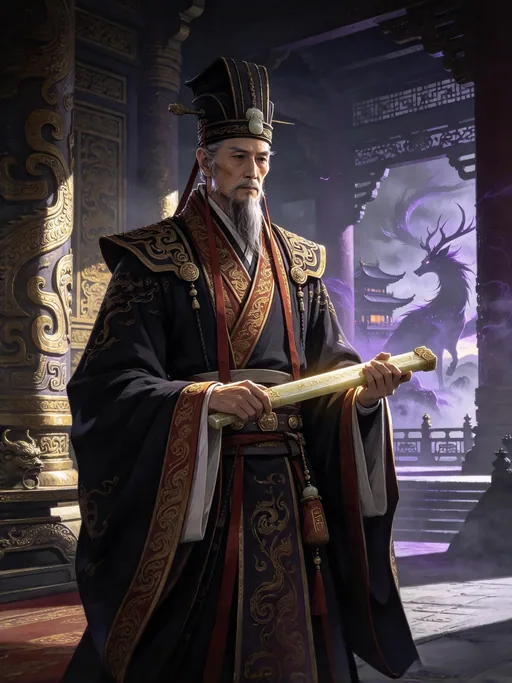
Bi Gan
MORTAL HEROES
比干
The youngest of the Sanxiao Sisters, a fiercely devoted and impulsive immortal who helped unleash the Nine-Meander Yellow River Formation, only to meet a tragic end at the hands of the supreme saints.
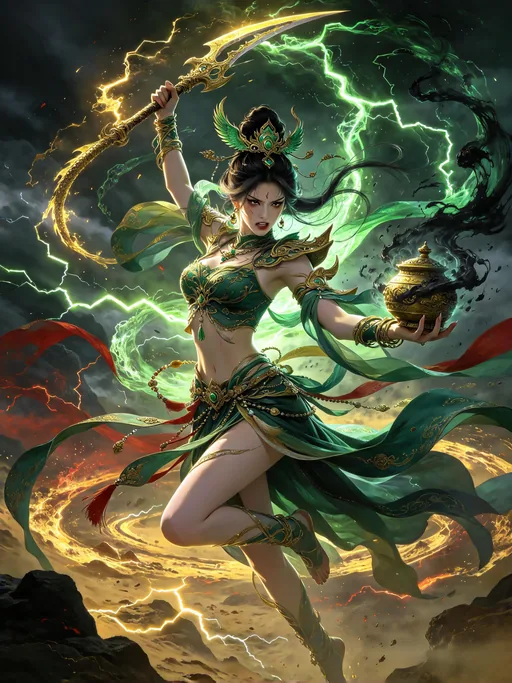
Bixiao Niangniang
IMMORTALS
碧霄娘娘
A beautiful maiden possessed by a thousand-year-old nine-tailed fox, sent by the goddess Nüwa to corrupt the Shang dynasty, only to be executed for her excessive cruelty.
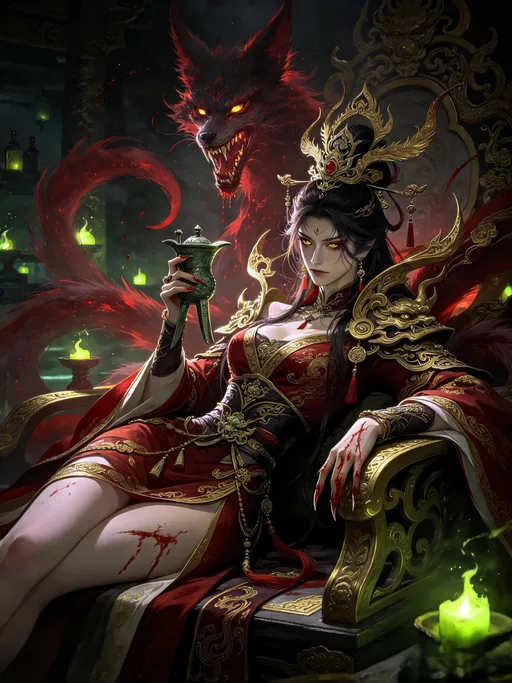
Da Ji
DEMONS
妲己
Deng Jiugong's daughter, a mortal general whose stones never miss a face. She wounded three Zhou champions and hit Kong Xuan three times when no immortal could touch him. Taken by a rope and married the same night to secure her father's defection, she fought for the Zhou until Gao Lanying blinded her with needles and cut her down. Enrolled as the Star of Six Harmonies.

Deng Chanyu
MORTAL HEROES
邓婵玉