Yu Yuan
余元The One-Qi Immortal of Penglai Island · Yu Yuan of Penglai
The One-Qi Immortal of Penglai Island, the Water-Office Star
A Jie alchemist who forged the blood-transforming blade, gave it to his disciple, and came down the mountain to avenge him — the novel's clearest case of invulnerability treated as a work of craft.
A body refined past the reach of blades, the alchemy of furnace and metal, and the limits of being unkillable
Identity and Place
Yu Yuan is a Jie cultivator of Penglai Island and a disciple of Jin Ling Shengmu. His title, the One-Qi Immortal, is a reputation rather than an office: he holds no formation, commands no troops, and appears on no rota of battle. He belongs to the older and quieter layer of the sect — the craftsmen.
That craft is the whole of his character. He works a furnace, and the novel is unusually precise about what he makes there: he separates dragon from tiger, fixes yin and yang, and draws out three elixir pills alongside a blade. The blade kills at the sight of blood, and he gives it to his disciple Yu Hua, an officer at Sishui Pass. This is the hinge of his story. The disciple uses the weapon; the Zhou camp discovers that nobody but its maker can cure the wound it leaves; Yang Jian goes to Penglai wearing the disciple's face and talks the three pills out of Yu Yuan's hand. The disciple then dies, and Yu Yuan comes down the mountain on no one's invitation, to settle a private account inside a war between two teachings.
A Body Made in a Furnace
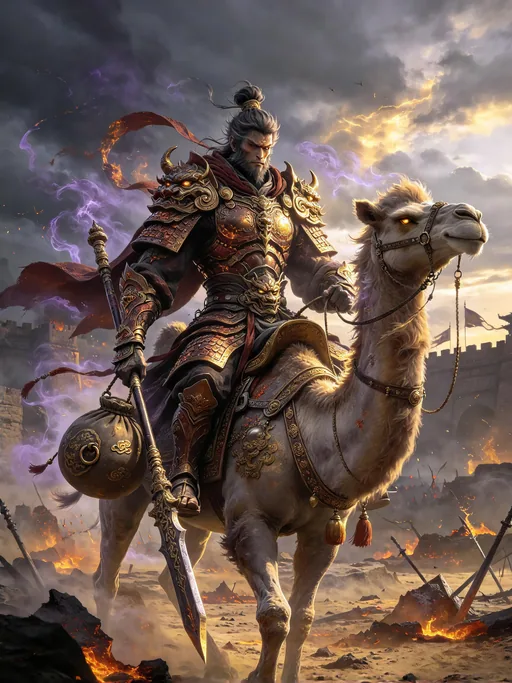
Everything about him is meant to be read at a glance: blue face, red hair, tusks, fish-tail crown, scarlet crane robe, and a height that clears ordinary men by a head and a half. The officers at the pass lose their nerve before he opens his mouth.
What matters is that the body was made, not given. He is the novel's clearest case of invulnerability treated as a technical achievement — his skin is a product of the furnace, described in the vocabulary of alchemy, and the text handles it as workmanship rather than blessing. Which is why the novel also takes care to show that he is not invincible in the ordinary sense: in his first field engagement the god-beating whip takes him across the back and drives the three-flame fire out of him a yard, Li Jing puts a spear through his leg, and he rides away. What is uncanny about him never appears on a battlefield. It appears in a prison, when the Zhou camp tries to execute a prisoner and finds that it cannot.
Three Treasures, Three Losses
Each of his three treasures fails in the same way: not broken, but taken out of the fight before it can be used. The blood-transforming knife is neutralised at its source the moment the only antidote leaves his hand. The Ruyi Qiankun Bag is kept under his meditation mat and used here not for storage but for execution — the prisoner is sealed inside, the bag itself set alight — until Ju Liusun arrives on a whirlwind, reaches down, and lifts bag and man away together.
The third is borrowed, and the terms of the loan define the Jie position in this whole episode: the Biyou Palace lends him the heart-piercing lock and tells him to bring Ju Liusun back unharmed. Nobody in this stretch of the story is trying to kill Yu Yuan; they are all trying to take him alive, which is exactly the problem his body creates. He never gets to use the lock. Ju Liusun will not come out to meet him, a rope comes down from somewhere above, and it is over in one exchange.
The Iron Cabinet and the Sea
Ju Liusun's solution is a jailer's, not a general's: build an iron cabinet, seal him inside, sink it in the North Sea. The cabinet is made, the yellow-scarf officers drop it, and the sea gives him back.
The explanation is alchemical and consistent with everything already established about him: iron belongs to the five metals and it is lying in water, so metal generates water and the water helps him instead of holding him. He escapes by water, surfaces still bound, and is found by a boy singing a Daoist song about how far the mountains and rivers lie. His master's reaction is not grief but insult — she carries it to Tongtian Jiaozhu as a question of the sect's face. The Grand Master has him brought in, lays a talisman on the rope, flicks it off with one finger, and then lends the lock, with a condition attached. The irony here is structural rather than personal: the Jie answer to a man who cannot be killed is to lend him a better way of capturing somebody, and the Zhou answer to the same problem is simply to move him somewhere else. Both sides have quietly stopped talking about execution, and neither says so.
The Blade and the Water Office
What ends him is not a stronger force but a different order of thing. Lu Ya's flying blade does not work by the five elements at all: a thread of white light rises from a gourd, something small with eyes and wings appears at its tip, and a head comes down. Lu Ya's verdict is administrative rather than cruel — Yu Yuan has acted against heaven and his name is already on the roster, so the sentence is merely being carried out — and he refuses to let the head be displayed, on the grounds that a man with an immortal body should not be left exposed.
The investiture names him Star of the Water Office, and the irony has no slack in it. He spent his life forging a body no weapon could enter. The Zhou could neither cut it nor hammer it, so twice they tried to move it out of the way, and the second attempt put him in water — and the water let him out. What the pantheon gives him is an office in water: the element that defeated the attempt to dispose of him becomes the element he governs. One discrepancy deserves recording for accuracy: the poem that introduces him places him in the grain office, which the roster does not. That is poetic language; the roster governs.
What He Is For
For a modern reader he sits closer to a design problem than to a character: a blue face, a mace thrown into the air, a bag under a cushion, a camel with light beneath its hooves. His function in the narrative is to be one of the war's problems that the war's own tools cannot solve, so that the solution must be imported from outside the system.
That is also why he is remembered out of proportion to his page count. He is the novel's test case for its own logic of power — a body built by technique, defeatable only by something outside the technique that built it. The blade that ends him is the same one that ends the white ape Yuan Hong eighteen chapters later, which is the novel's way of saying that this was never really about Yu Yuan.
More from this collection
A Shang grand counselor and royal uncle of King Zhou, killed on Daji's demand for his seven-orifice heart. His death became one of the dynasty's defining crimes, and he was apotheosized as the Lord of the Wenqu Star.
Bi Gan
MORTAL HEROES
比干
The youngest of the Sanxiao Sisters, a fiercely devoted and impulsive immortal who helped unleash the Nine-Meander Yellow River Formation, only to meet a tragic end at the hands of the supreme saints.
Bixiao Niangniang
IMMORTALS
碧霄娘娘
A beautiful maiden possessed by a thousand-year-old nine-tailed fox, sent by the goddess Nüwa to corrupt the Shang dynasty, only to be executed for her excessive cruelty.
Da Ji
DEMONS
妲己
Deng Jiugong's daughter, a mortal general whose stones never miss a face. She wounded three Zhou champions and hit Kong Xuan three times when no immortal could touch him. Taken by a rope and married the same night to secure her father's defection, she fought for the Zhou until Gao Lanying blinded her with needles and cut her down. Enrolled as the Star of Six Harmonies.
Deng Chanyu
MORTAL HEROES
邓婵玉