Lü Yue
吕岳The Plague Ancestor · Great Emperor of Pestilence
Great Emperor of Pestilence, Lord of the Plague Ministry
A Jie faction immortal of Nine Dragon Island, three-headed and six-armed, who spread plague through Western Qi and was finally apotheosized as the Great Emperor of Pestilence, commander of the Plague Ministry.
Sovereignty over plague, epidemic, and the spread of disease
Identity and Origins
Lü Yue is a Jie faction immortal based at Nine Dragon Island's Sound-Name Mountain (九龙岛声名山). The novel introduces him late, in Chapter 58, at a point when the Shang campaign against Western Qi has stalled and the Shang commanders are looking for weapons that conventional warfare cannot counter. Lü Yue arrives as exactly that weapon. He is not a swordsman or a formation master in the usual sense; he is a specialist in pestilence, and his art is the art of making an army sick.
His sectarian identity matters. He is a Jie disciple, and his intervention is framed as part of the larger conflict between the Jie and Chan teachings. But the novel gives him a domain that is distinct from any other Jie immortal: he does not fight with flying swords or immortal treasures in the ordinary sense. He fights with contagion. His weapons are the Plague Umbrella, the Xingtian Seal, the Plague Bell, the Plague-Fixing Banner, and the Plague-Pointing Sword — objects designed not to kill a single opponent but to infect a population.
This makes him, in the novel's moral geography, a particularly disturbing kind of enemy. The Fengshen Yanyi is full of warriors who kill, but Lü Yue is one of the few whose method is to make the innocent sick. His eventual apotheosis as the god of plague is therefore not a reward for virtue. It is the novel's acknowledgment that pestilence is a power that must be governed, and that the being who governs it is the being who once wielded it.
Appearance and Iconography
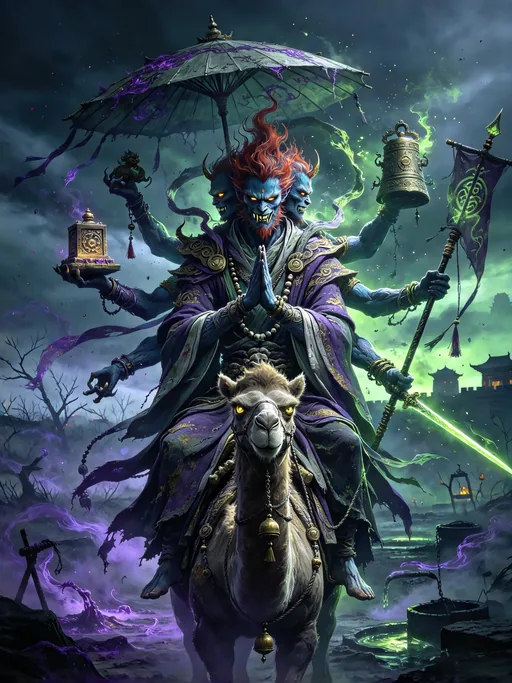
Lü Yue's appearance is one of the most deliberately hideous in the Fengshen corpus. He is described as having a face like indigo, red hair, protruding fangs, and — in his full manifestation — three heads and six arms. The three heads allow him to see in all directions while working; the six arms allow him to wield his five plague treasures simultaneously. He rides a Golden-Eyed Camel, a mount whose slow, heavy gait suits a figure who does not need speed because his weapon travels through water and air.
The iconography is coherent in a way that few Fengshen designs are. Every one of his treasures corresponds to a mode of contagion. The Plague Umbrella releases disease-bearing miasma. The Xingtian Seal stamps a mark that fixes the plague in a body. The Plague Bell spreads infection through sound. The Plague-Fixing Banner anchors the disease in a place. The Plague-Pointing Sword directs it at a chosen target. Together they form a complete apparatus of epidemic warfare, and Lü Yue's six arms exist precisely so that he can operate all of them at once.
His visual language is therefore not decorative monstrosity. It is functional monstrosity: a body designed around its weapons, the way a siege engine is designed around its payload.
The Poisoning of Western Qi
Lü Yue's first campaign is his most consequential. Invited by the Shang commander Su Hu, he enters Western Qi not through the gates but through the water. He casts plague pills into the city's wells and water sources, and the entire population falls ill. The novel describes the city in terms of its symptoms: soldiers unable to lift their weapons, officials unable to stand, the streets filled with the moaning of the sick. It is one of the few passages in the Fengshen Yanyi that reads like a plague chronicle rather than a battle narrative.
The Zhou side cannot fight back with conventional means. Jiang Ziya himself is afflicted. It is Yang Jian who travels to seek a cure, and it is Yang Ren — newly descended from Green Peak Mountain with the Five-Fire Seven-Bird Fan — who becomes the counter to Lü Yue's plague. The fan's five fires burn away the miasma, and Lü Yue is driven off, wounded, back to Nine Dragon Island.
This first campaign also claims his disciples. As Lü Yue's followers sally out to hold the Zhou camp at bay, Zhou Xin, Li Qi, Zhu Tianlin, and Yang Wenhui are slain one by one by the Chan masters and Zhou champions. This establishes the structure of his rivalry with Yang Ren. Lü Yue attacks the body; Yang Ren's fan attacks the plague itself. The novel pairs them because they are mirror specialists: one spreads disease through a population, the other burns disease out of the air. Their later confrontations are repetitions of this first one, with the stakes raised each time.
The Plague Formation
Lü Yue's second and final campaign is the Plague Formation (瘟癀阵). When he returns to the war, he brings with him not his lost disciples but his fellow disciples Chen Geng and Li Ping — Li Ping, notably, urging him at every turn to give up the fight he cannot win. The formation is not a maze of walls and gates like the Ten Absolute Formations. It is an atmosphere. Those who enter it breathe the plague, and the plague works on them from the inside.
The formation traps Jiang Ziya for a hundred days. The novel uses the interval to stage a series of attempts to break it, each of which fails because the Jie formation is not vulnerable to the same methods as the others. It is Yang Ren, again, who provides the counter: the Five-Fire Seven-Bird Fan burns through the plague miasma and allows the Zhou side to reach Lü Yue himself. In the final confrontation, Lü Yue is burned to ash, and Chen Geng and Li Ping die with him.
The Plague Formation is the novel's most sustained treatment of epidemic as a weapon of war. It is also the episode that secures Lü Yue's place in the pantheon, because the god who is enthroned over plague is the god who demonstrated, at the cost of his own life, how plague works.
Death and Apotheosis
Lü Yue is killed in the breaking of the Plague Formation, burned out by Yang Ren's Five-Fire Seven-Bird Fan. His death is not a duel in the ordinary sense. It is the collapse of an apparatus: the plague master, his two fellow disciples, and his formation are destroyed together, and the air over the battlefield clears.
After the war, Jiang Ziya enrolls him among the 365 gods as the Great Emperor of Pestilence (瘟癀昊天大帝), the presiding deity of the Plague Ministry. His four disciples are enrolled as the Plague Messengers of the four directions: Zhou Xin of the East, Li Qi of the South, Zhu Tianlin of the West, and Yang Wenhui of the North. Chen Geng and Li Ping join them as Assistant Directors of the ministry, so that the Plague Ministry stands complete with six appointed gods beneath its emperor. It is one of the most feared offices in Chinese popular religion, because it governs a power that no offering can fully avert.
The apotheosis is not a redemption. The novel does not soften Lü Yue's method or forgive his attack on a civilian population. What it does is assign him an office that matches his nature. In the Fengshen system, gods are not made from the virtuous alone; they are made from the powers that the cosmos needs to have governed. Plague is such a power, and Lü Yue is its governor.
Cultural Legacy
Lü Yue's legacy is the legacy of the Plague Ministry, one of the most widely propitiated offices in Chinese popular religion. The plague deities of the Fengshen system — Lü Yue, his four directional messengers, and his two fellow disciples — appear in Daoist ritual, in local temple traditions, and in the folk practice of "sending off the plague" (送瘟), in which communities parade the plague gods out of their territory at the end of an epidemic. The Fengshen Yanyi did not invent this cult, but it gave it a narrative genealogy: the plague gods are the Jie immortal who poisoned the wells and the disciples who helped him.
This genealogy is morally uncomfortable, and the novel seems to know it. Lü Yue is not a sympathetic figure. He attacks civilians, he uses disease as a weapon, and he is defeated by a fire that purifies the air. Yet he is enthroned. The Fengshen system does not require its gods to be good; it requires them to be the right governors of the right powers.
For English-language readers, Lü Yue is therefore a useful case for understanding how Chinese popular religion thinks about dangerous deities. The plague god is not worshipped because he is loved. He is worshipped because he must be managed, and because the alternative — an ungoverned plague — is worse. The Fengshen Yanyi turns that theological necessity into a character, and the character is a three-headed, six-armed immortal on a camel, carrying an umbrella full of disease.
More from this collection
A Shang grand counselor and royal uncle of King Zhou, killed on Daji's demand for his seven-orifice heart. His death became one of the dynasty's defining crimes, and he was apotheosized as the Lord of the Wenqu Star.
Bi Gan
MORTAL HEROES
比干
The youngest of the Sanxiao Sisters, a fiercely devoted and impulsive immortal who helped unleash the Nine-Meander Yellow River Formation, only to meet a tragic end at the hands of the supreme saints.
Bixiao Niangniang
IMMORTALS
碧霄娘娘
A beautiful maiden possessed by a thousand-year-old nine-tailed fox, sent by the goddess Nüwa to corrupt the Shang dynasty, only to be executed for her excessive cruelty.
Da Ji
DEMONS
妲己
Deng Jiugong's daughter, a mortal general whose stones never miss a face. She wounded three Zhou champions and hit Kong Xuan three times when no immortal could touch him. Taken by a rope and married the same night to secure her father's defection, she fought for the Zhou until Gao Lanying blinded her with needles and cut her down. Enrolled as the Star of Six Harmonies.

Deng Chanyu
MORTAL HEROES
邓婵玉