Su Hu
苏护Father of Daji
Marquis of Jizhou, first of the Eastern Dipper Star-Officers
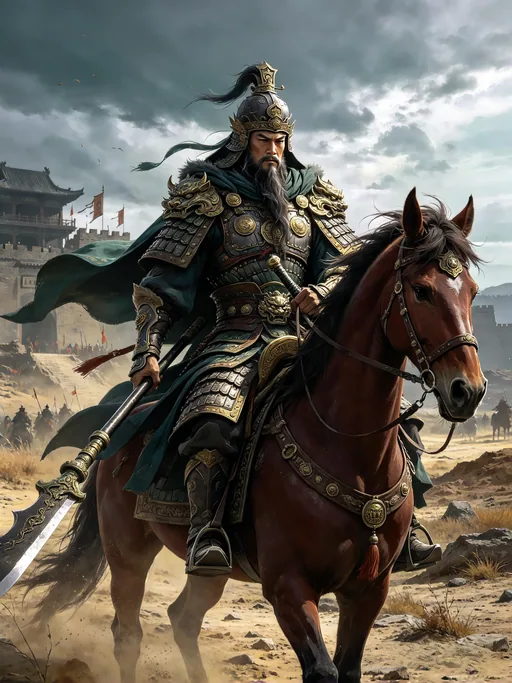
The Marquis of Jizhou, who answered an extortion by refusing to give up his daughter, was beaten into submission, presented a girl already possessed by a fox-spirit, served the Shang against the Zhou, then changed sides and died at the Tong Pass. Enrolled first among the Eastern Dipper Star-Officers.
Frontier lordship, the honour of a house, and a loyalty that changed sides twice
A Border Lord and a Bill He Would Not Pay
Su Hu is the Marquis of Jizhou, a frontier lord of the northern border. He is not one of the four great regional lords — Jizhou lies inside the territory of the Northern Marquis Chong Houhu, which decides who comes to besiege him later. He has a wife, a daughter named Daji, and a grown son, Su Quanzhong.
His story begins not with a hero's grievance but with a bribe he declined to pay: when the lords came to court, the favourites Fei Zhong and You Hun openly collected gifts, and Su Hu, who thought the practice shameful, sent nothing. They took it personally, and their revenge was a recommendation — the king was told that his daughter was a beauty without equal. The summons that followed was the same bill presented twice. His revolt is therefore not the work of a man with a programme, but of a man extorted, slandered and ordered to hand over his daughter, who reached for the one lever a lord of his rank has.
Sixteen Characters on the Gate
The court scene is the novel's first confrontation between a lord and a tyrant, and it is short. Su Hu is told his daughter has been chosen and that he is to present her, and refuses to his face: the palace is already full, the demand is unjust, and to take a lord's daughter by force dishonours both the lord and the crown. The king orders him executed — and then the men who destroyed him save him, Fei Zhong and You Hun asking that he be spared and sent home, calculating that a lord who owes his life to the throne will hand over his daughter out of gratitude.
On his way out he stops at the Meridian Gate and writes sixteen characters on the wall, naming an injury and signing it with his name and his city. It is worth being exact about what the gesture is not: there is no programme in it, no claim about how a realm should be governed, only a public refusal. A gatekeeper copies it down and carries it to the king, and from that sheet of paper the war with Jizhou becomes official — because it names a wound, not a cause.
Under the Walls of Jizhou
The throne sends two lords, Ji Chang of the West and Chong Houhu of the North, and only one of them comes. Ji Chang wants no quarrel with Su Hu and takes up a supporting position without hurrying to arrive — obstruction that costs him nothing and buys Su Hu time. Chong Houhu advances and is beaten back repeatedly by Su Quanzhong. Then his brother arrives: Chong Heihu, trained under a Jie immortal, opens the gourd on his back and releases an iron-beaked eagle that breaks the boy and takes him prisoner.
With his heir in a cage and the army at the wall, Su Hu does the hardest thing in his story, the scene most retellings leave out: he takes his sword into the inner hall intending to kill his wife and daughter and then himself, reasoning that the disaster came of having such a daughter and that it is better to end his house than hand it over. He is stopped by his grain officer Zheng Lun, just back from the roads, who hears the situation and rides out without a word, drops Chong Heihu with two beams of white light from his nose, and has him carried in bound. Su Hu unties him personally and sets out wine — and the honoured prisoner spends the banquet urging him to do the thing he had just been ready to die rather than do.
A Letter, and a Post Station
What finally settles it is not a siege engine but a letter. Ji Chang, having avoided the fighting, sends his chief minister San Yisheng with a sealed argument: do not, for the sake of one girl, set yourself against the Son of Heaven and invite your own destruction. He does not come in person and does not threaten, and the writing is enough, because by now the arithmetic has been done for Su Hu by everyone else — his son in a cage, his city one push from falling, his household three steps from a sword. He agrees, has Daji dressed and made ready, and escorts her himself.
On the road they stop at Enzhou Post Station. In the third watch the maids raise an alarm; by morning the girl who rises and continues the journey is not Su Hu's daughter. A thousand-year fox-spirit has taken her body and her name. Everything the novel does with him afterwards depends on this, and the novel is exact about the limit of his knowledge: he never finds out. He delivers a demon to the court believing he has delivered his child, and spends the rest of the book acting on a family situation that no longer exists. The reader knows; he does not. That gap is where his tragedy actually lives.
The Defection That Took Four Campaigns
Su Hu's later service is one of the novel's longest-running jokes at the throne's expense. Ordered west against the Zhou, he marches out with a plan already formed: bring his whole household in the baggage train and go over to King Wu, so that he may not be laughed at by the other lords nor mocked by later ages. The novel spends several chapters on the failure of that plan, and none of the failure is his fault.
First Zheng Lun blocks it — his own grain officer catches Huang Feihu and his sons, which makes defection impossible without abandoning them, and Su Hu quietly lets them go instead. Then Shen Gongbao arrives and drags in reinforcements to keep the campaign alive, each of whom must be dealt with first. When it finally happens it is done from inside: he coordinates with the Zhou camp, brings his army over, and talks Zheng Lun into coming with him. Jiang Ziya's verdict is the highest compliment the novel pays a defector — not a man of small loyalties but one who read the times and chose the light.
The Pass, and the Roster
Su Hu dies at the Tong Pass, still trying to earn his place. Three of the five passes are down; the Tong Pass is held by Yu Hualong and his four sons, and after the eldest kills Ta Luan with a concealed mace, Su Hu asks for the assignment the next morning. His opponent, the second son, opens with a speech rather than a stroke — you were a kinsman of the throne by marriage, your family ate the state's bounty for generations, how do you forget all that and turn rebel. Su Hu's answer is the shortest summary of his politics in the book: most of the realm is no longer Shang, so what is one pass.
They exchange fewer than ten blows. The young man takes out a yellow flag, unfurls it, and vanishes with his horse in a flicker of golden light; Su Hu turns to look, hears hooves behind him, wheels too late, and takes a spear under the ribs. His son rides out the next day to avenge him and comes back with three darts in him. The roster puts Su Hu first among the four Eastern Dipper Star-Officers and the son among the Northern Dipper as the Star of the Broken Army, and it sorts him neither as traitor nor loyalist — the Investiture counts names on a list, not constancy. That is the right verdict: what he had was not a principle but a series of positions, each defensible when taken, each undone by the next.
More from this collection
A Shang grand counselor and royal uncle of King Zhou, killed on Daji's demand for his seven-orifice heart. His death became one of the dynasty's defining crimes, and he was apotheosized as the Lord of the Wenqu Star.
Bi Gan
MORTAL HEROES
比干
The youngest of the Sanxiao Sisters, a fiercely devoted and impulsive immortal who helped unleash the Nine-Meander Yellow River Formation, only to meet a tragic end at the hands of the supreme saints.
Bixiao Niangniang
IMMORTALS
碧霄娘娘
A beautiful maiden possessed by a thousand-year-old nine-tailed fox, sent by the goddess Nüwa to corrupt the Shang dynasty, only to be executed for her excessive cruelty.
Da Ji
DEMONS
妲己
Deng Jiugong's daughter, a mortal general whose stones never miss a face. She wounded three Zhou champions and hit Kong Xuan three times when no immortal could touch him. Taken by a rope and married the same night to secure her father's defection, she fought for the Zhou until Gao Lanying blinded her with needles and cut her down. Enrolled as the Star of Six Harmonies.

Deng Chanyu
MORTAL HEROES
邓婵玉