Shiji Niangniang
石矶娘娘Lady Shiji of the White Bone Cave · The Stone Spirit of Skull Mountain
Lady of the White Bone Cave, the Moon-Wandering Star
A stone spirit who cultivated to human form at Skull Mountain's White Bone Cave, who came to seek justice when Nezha's arrow killed one disciple and Nezha himself killed the other, and who was burned back to her original stone by Taiyi Zhenren's Nine-Dragon Fire-Sphere.
Sovereignty over stone and bone, and the office of the Moon-Wandering Star
Identity and Origins
Shiji Niangniang is not born. She is a stone that cultivated. The novel is explicit about this: she is a ten-thousand-year stone on Skull Mountain (骷髅山) that has absorbed the vital forces of heaven and earth long enough to take human form. Her cave is called the White Bone Cave (白骨洞), and her two disciples — the boys Bi Yun and Cai Yun — serve her there. She is a Jie immortal, but of a particular kind: not a disciple of Tongtian Jiaozhu with a formal lineage, but a self-made spirit who has attained the Dao without a teacher.
This origin matters for everything that follows. In the Fengshen Yanyi's hierarchy of beings, a stone that has cultivated to human form is a marginal figure. She has power — she can fly on cloud, she can wield treasures, she can fight — but she has no sect to protect her, no master to appeal to, and no place in the cosmic order that the war is fighting over. She is, in the novel's terms, a “loose immortal” (散仙) of the Jie alignment: aligned with the Jie teaching by temperament and by the company she keeps, but not embedded in its hierarchy.
Her name is descriptive rather than genealogical. “Shiji” means “stone outcrop” or “rock”; “Niangniang” is a respectful title for a female deity or lady. She is Lady Stone of Skull Mountain, and the novel never lets the reader forget that the lady is, at bottom, a rock.
Appearance and Iconography
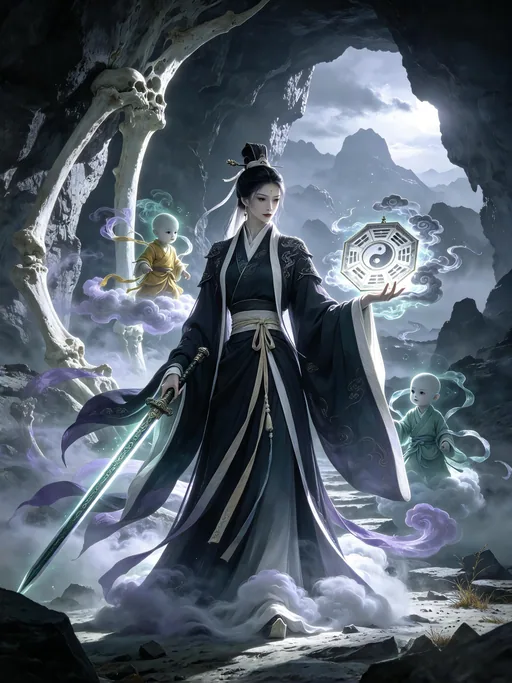
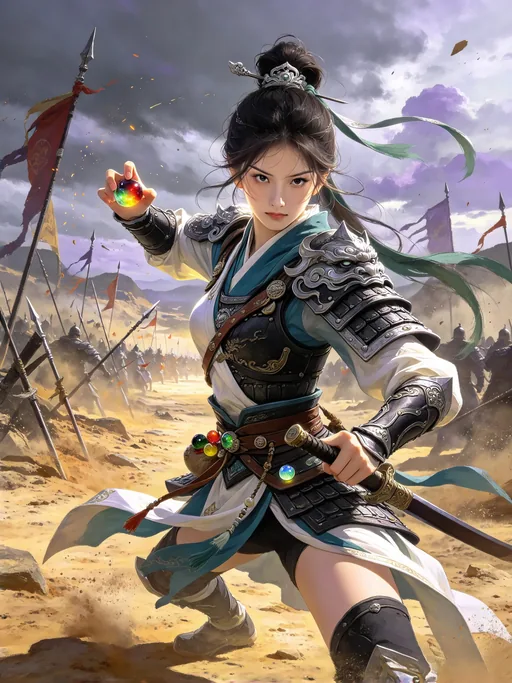
In human form, Shiji Niangniang is described as a dignified female immortal, often depicted as a woman in her thirties with a composed, slightly severe face, dressed in dark Daoist robes with pale trim. She wears a Daoist crown and carries the Eight-Trigram Cloud-Light Kerchief (八卦云光帕), a treasure that can release cloud and light to bind or confuse an opponent, and the Tai'e Sword (太阿剑), a blade of considerable sharpness.
Her iconography is built around the contrast between her refined human appearance and her stone origin. The White Bone Cave is named for bone, not for stone, and the novel uses the name to signal that her domain is a place of death and endurance rather than of life and growth. The two boy disciples are her only attendants; when they are killed, the cave becomes a place of grief before it becomes a place of vengeance.
Her true form, revealed only at the end, is a stone — not a monstrous shape, but a plain, ten-thousand-year rock. The novel's visual logic is that her human form is a garment, and the garment can be burned away. When Taiyi Zhenren's fire-sphere closes over her, what remains is what was always there.
The Arrow and the Disciples
The episode that sets Shiji Niangniang's fate in motion begins with an accident that is also a violation. Nezha, then a child, is playing on the city wall of Chentang Pass with the Qiankun Bow and the Heaven-Shaking Arrow (震天箭), two treasures that had been left in the armory. He draws the bow and looses the arrow. The arrow flies to Skull Mountain and strikes Bi Yun, Shiji Niangniang's disciple, killing him where he stands.
The novel is careful about the moral structure of this scene. Nezha does not intend to kill anyone. He is a child playing with a weapon he does not understand. But the arrow is a treasure of Chentang Pass, and the pass is Li Jing's responsibility, and the dead boy is Shiji Niangniang's. The killing is accidental, but the responsibility is not diffuse. Someone must answer for it.
Shiji Niangniang comes to Chentang Pass to demand that answer. The interview goes badly: Nezha, who has already killed the Dragon King's son and is in no mood to be scolded, meets her disciple Cai Yun and strikes him down with the Qiankun Ring. Now both boys are dead. Shiji Niangniang does not come to negotiate after that. She comes as a mistress of a household whose children have been killed, and the novel gives her the full moral weight of that position. She is not a villain in this scene. She is a bereaved teacher demanding that the father of the killer produce the killer.
The Confrontation with Nezha
The confrontation that follows is one of the novel's earliest and clearest illustrations of how power works in the Fengshen world. Shiji Niangniang confronts Nezha, and Nezha fights her. He is outmatched. She is a ten-thousand-year stone spirit with treasures and experience; he is a child with a spear and a ring.
Nezha flees to his master, Taiyi Zhenren, at the Dry Jade Mountain's Golden Light Cave. This is the moment when the confrontation stops being a dispute between two parties and becomes a dispute between two teachings. Shiji Niangniang follows him to the cave and demands that Taiyi produce his disciple. Taiyi refuses. He does not deny that Nezha killed the two boys. He argues that the killing was fated, that Nezha is a figure of destiny, and that Shiji Niangniang — a stone spirit with no lineage — has no standing to demand satisfaction from a disciple of the Chan teaching.
The novel stages this as a debate, but the debate is a formality. Taiyi has already decided to destroy her. The question is not whether Nezha is guilty. The question is whether a loose Jie immortal has the right to hold a Chan disciple accountable. The answer, in the novel's political logic, is no.
The Nine-Dragon Fire-Sphere
Taiyi Zhenren destroys Shiji Niangniang with the Nine-Dragon Fire-Sphere (九龙神火罩), a treasure that releases nine dragons of fire to surround and burn the target. The novel describes the burning in physical detail: the fire closes over her, her human form is burned away, and what remains is her original form — a stone.
The scene is one of the novel's most pointed statements about the relation between the Chan and Jie teachings. Shiji Niangniang is not killed in battle. She is not defeated by a superior warrior. She is executed by a master who has decided that her claim is invalid because of who she is. The fire-sphere is not a weapon of war; it is an instrument of judgment, and the judgment is that a stone spirit who cultivated without a sect has no standing against a disciple of the Chan.
The novel does not comment on the justice of this. It records it. And in recording it, it establishes one of the patterns that will recur throughout the Investiture War: the Jie immortals are destroyed not only by superior force but by a hierarchy that has already decided they do not count.
Fate, Apotheosis, and Legacy
Shiji Niangniang is killed by Taiyi Zhenren, and her name is entered on the Fengshen roster. After the war, Jiang Ziya enrolls her among the 365 gods as the Moon-Wandering Star, one of the minor offices tied to the moon's course. The office is not a major one, but it is an office, and the novel treats her enrollment as consistent with the system's logic: every power that the war concentrates must be stabilized somewhere. Her apotheosis is not a vindication. It is the system doing what systems do — taking a being it destroyed and assigning her a place in the cosmos that destroyed her. She becomes a star, but a minor one, and the master who burned her remains a master of the winning teaching.
Her importance is structural rather than devotional. She has no cult and no independent myth cycle, and she is remembered, when she is remembered, as the first Jie immortal destroyed by Chan power. She establishes the pattern the rest of the war will repeat at larger scale: a figure with a legitimate grievance, destroyed by someone who has both the power and the doctrinal justification to do it. Nezha's two killings are an accident and a hot-tempered second blow; Taiyi's killing of her is a judgment, and the novel sets them side by side. She also introduces the category of the unaffiliated cultivator — power without a sect, and therefore power without protection. In a war between two teachings, that is the most exposed position there is, and her burning is the first time the reader learns what the Investiture is going to cost.
More from this collection
A Shang grand counselor and royal uncle of King Zhou, killed on Daji's demand for his seven-orifice heart. His death became one of the dynasty's defining crimes, and he was apotheosized as the Lord of the Wenqu Star.
Bi Gan
MORTAL HEROES
比干
The youngest of the Sanxiao Sisters, a fiercely devoted and impulsive immortal who helped unleash the Nine-Meander Yellow River Formation, only to meet a tragic end at the hands of the supreme saints.
Bixiao Niangniang
IMMORTALS
碧霄娘娘
A beautiful maiden possessed by a thousand-year-old nine-tailed fox, sent by the goddess Nüwa to corrupt the Shang dynasty, only to be executed for her excessive cruelty.
Da Ji
DEMONS
妲己
Deng Jiugong's daughter, a mortal general whose stones never miss a face. She wounded three Zhou champions and hit Kong Xuan three times when no immortal could touch him. Taken by a rope and married the same night to secure her father's defection, she fought for the Zhou until Gao Lanying blinded her with needles and cut her down. Enrolled as the Star of Six Harmonies.
Deng Chanyu
MORTAL HEROES
邓婵玉