Huang Feihu
黄飞虎Martial King Cheng of Shang · Great Emperor of Mount Tai
Martial King Who Defected from Shang
A mortal general of the Shang court whose family was destroyed by King Zhou, he defected to Zhou and became one of its founding commanders, and after death was enthroned as the Great Emperor of Mount Tai.
Lordship of Mount Tai and the underworld; patron of the wronged
Identity and Origins
Huang Feihu is the one major figure in the Fengshen Yanyi who is, at the story's outset, neither an immortal nor a rebel. He is the Zhenguo Wucheng Wang — the "Martial King Who Guards the State" — of the Shang court, the commander of its armies and one of the seven generations of the Huang family that had served the Shang throne. His father Huang Gun is a border general; his sister is a consort of King Zhou; his wife Jia Shi is a noblewoman of the court. He is, in short, the establishment.
This matters because the novel needs a character whose loyalty is not abstract. Huang Feihu does not serve an idea of the Shang; he serves a specific dynasty that his ancestors helped build. His defection is therefore not a young man's rebellion but a senior commander's judgment that the throne has become incompatible with the order he was sworn to defend. The novel treats this as a genuine moral crisis, not a plot convenience.
Appearance and Iconography
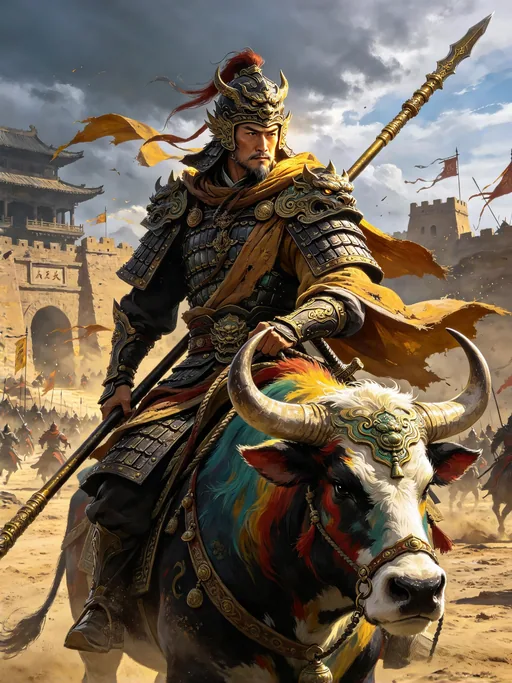
Huang Feihu's visual identity is that of the mature mortal commander: a broad-faced, heavy-browed man in his prime, with a short beard and the scarred calm of someone who has spent decades in armor. He wears the layered heavy armor of a Shang general, dark iron and bronze with gold-chased edges, and over it a yellow war cloak. His weapon is the gold-chased spear (金錾提芦枪), a practical cavalry lance rather than a magical treasure.
His mount is the Five-Colored Divine Ox, a beast whose hide shifts through five hues and whose horns are broad enough to carry a banner. The ox is the one fantastical element in his otherwise grounded silhouette, and it signals that he is a mortal who has been admitted into the novel's supernatural economy without becoming an immortal. Where Nezha has wheels of fire and Yang Jian has a heavenly eye, Huang Feihu has a warhorse — an ox — and a spear. His iconography is the iconography of ordinary martial excellence raised to the level of myth.
The Wronged Family and the Five Passes
The crisis arrives through the palace. King Zhou, under the influence of Daji, summons Huang Feihu's wife Jia Shi to the inner court and attempts to violate her; she throws herself from the tower and dies. When Huang Feihu's sister, the consort Huang Fei, protests, she too is killed. In a single night, the throne has destroyed Huang Feihu's family not on the battlefield but in the most intimate and dishonorable way possible.
Huang Feihu's response is the novel's first great defection. He gathers his household, his brothers, and his retainers and rides for the western border, intending to cross five passes and seek asylum with King Wu of Zhou. The "Five Passes" sequence (过五关) is his defining adventure: at each pass a Shang general tries to stop him, and at each pass he fights his way through, sometimes with the help of immortals who have been sent to assist him. The sequence is structured like a gauntlet, and its point is that Huang Feihu does not sneak away. He announces his defection and then survives the consequences.
The Zhou Commander
In Zhou, Huang Feihu is received as a founding noble and given the title of Founding Martial King (开国武成王). His role in the Investiture War is different from that of the immortals: he commands mortal troops, holds formations, and provides the conventional military backbone that the supernatural warriors cannot replace. When Jiang Ziya needs a line to hold while a formation is broken, it is Huang Feihu's cavalry and infantry that hold it.
His son Huang Tianhua, taken as a child by the immortal Qingxu Daode Zhenjun, returns as a young warrior with magical treasures and fights alongside his father. The father-son pairing is one of the novel's warmer threads: Huang Feihu is the grounded commander, Huang Tianhua the dazzling young immortal-in-training, and their campaigns together give the Zhou side a family unit that mirrors the novel's larger theme of generational transmission. Huang Feihu's final campaign is the eastern drive through the Shang heartland's passes, which ends for him at Mianchi.
Death at Mianchi and Apotheosis
Huang Feihu's death comes at Mianchi (渑池县), during the final campaign against the Shang loyalist Zhang Kui. Zhang Kui is a formidable mortal general with a supernatural mount and a wife, Gao Lanying, who fights with equal skill. In the fighting, Huang Feihu is killed — the novel gives him a soldier's death, not a martyr's spectacle. His son Huang Tianhua had already fallen years earlier at Golden Rooster Ridge, killed by Gao Jineng's bag of wasps. The Huang family's arc, which began with a night of palace violence, ends with a father and son who both die in the war, on different battlefields.
After the war, Jiang Ziya enrolls Huang Feihu among the 365 gods as the Great Emperor of Mount Tai, the Eastern Peak, with authority over the underworld and the register of human life and death. The title is not a consolation prize. In Chinese religious geography, Mount Tai is the axis of the dead, and the Eastern Peak Emperor is one of the most powerful deities in the popular pantheon. The mortal commander who was wronged by a king becomes, in death, the judge of kings and commoners alike.
Cultural Legacy
Huang Feihu's legacy is double. In literature, he is the model of the righteous defector: a man who does not rebel out of ambition but because the throne has violated the moral order he was sworn to uphold. The phrase "君不正则臣投外国" — when the ruler is unjust, the minister may seek another country — is often attached to his story, and it made him a usable figure for later political thought about the limits of loyalty.
In religion, he is the Eastern Peak Emperor, one of the most widely worshipped deities in Chinese popular religion. His temples are found across northern China, and his authority over the dead made him a central figure in funerary practice. The novel's decision to identify the Shang defector with the Emperor of Mount Tai is one of its most consequential merges: it takes a narrative hero and fuses him with a pre-existing cult, so that the literary character and the god became difficult to separate. For English-language readers, Huang Feihu is therefore a useful entry point into how the Fengshen Yanyi does not merely tell stories about gods but actively reorganizes the pantheon it inherits.
More from this collection
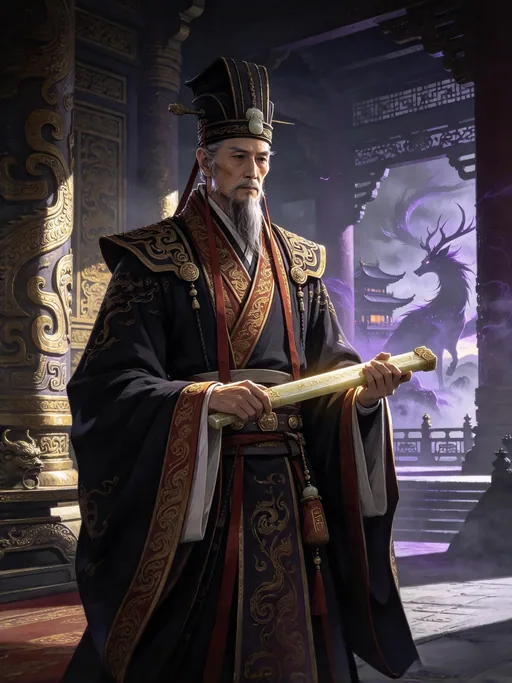
A Shang grand counselor and royal uncle of King Zhou, killed on Daji's demand for his seven-orifice heart. His death became one of the dynasty's defining crimes, and he was apotheosized as the Lord of the Wenqu Star.
Bi Gan
MORTAL HEROES
比干
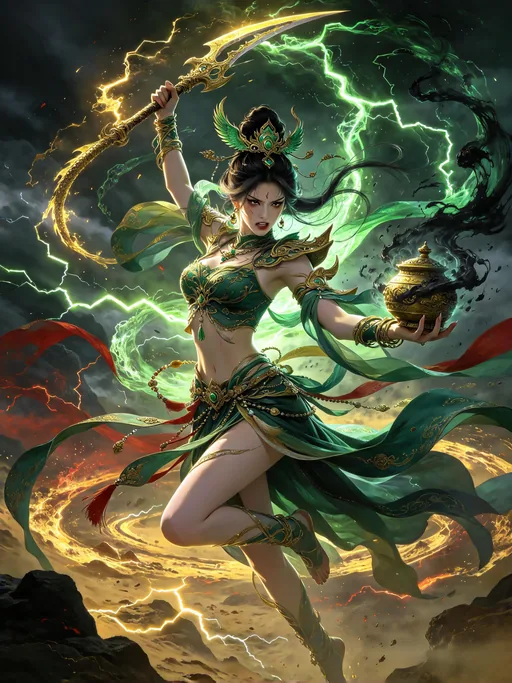
The youngest of the Sanxiao Sisters, a fiercely devoted and impulsive immortal who helped unleash the Nine-Meander Yellow River Formation, only to meet a tragic end at the hands of the supreme saints.
Bixiao Niangniang
IMMORTALS
碧霄娘娘
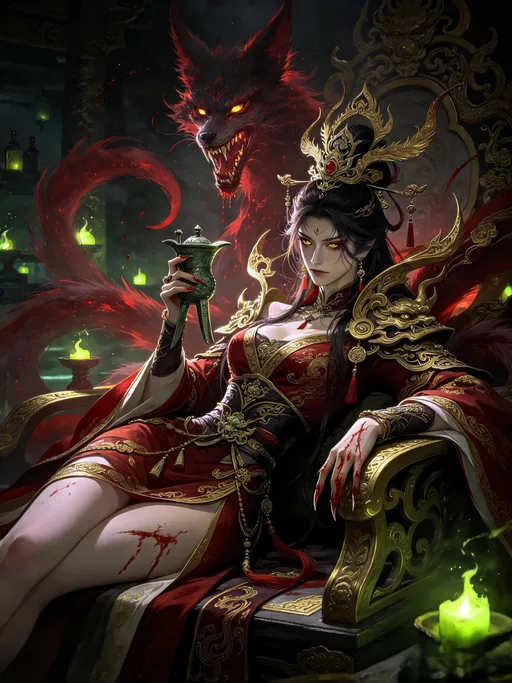
A beautiful maiden possessed by a thousand-year-old nine-tailed fox, sent by the goddess Nüwa to corrupt the Shang dynasty, only to be executed for her excessive cruelty.
Da Ji
DEMONS
妲己
Deng Jiugong's daughter, a mortal general whose stones never miss a face. She wounded three Zhou champions and hit Kong Xuan three times when no immortal could touch him. Taken by a rope and married the same night to secure her father's defection, she fought for the Zhou until Gao Lanying blinded her with needles and cut her down. Enrolled as the Star of Six Harmonies.
Deng Chanyu
MORTAL HEROES
邓婵玉