Ji Fa
姬发King Wu of Zhou · Zhou Wuwang
King Wu of Zhou, the Martial King
The second son of Ji Chang and the founding king of Zhou, who made Jiang Ziya his minister and defeated the Shang at Muye.
Sovereignty over the Zhou dynasty and the mandate of heaven
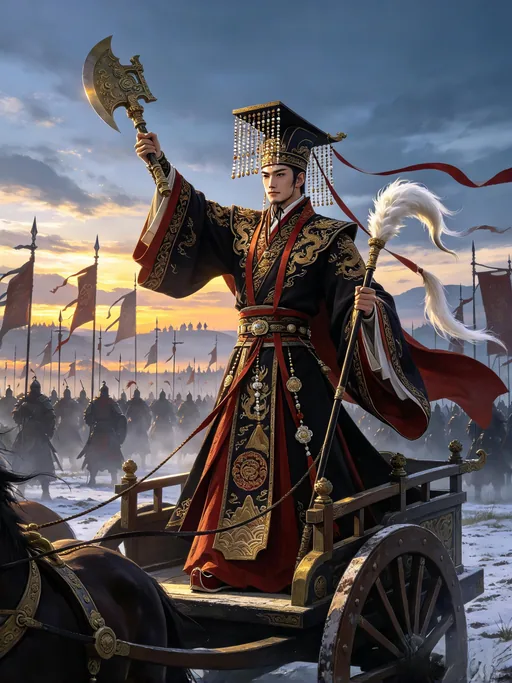
The Second Son, Not the Heir
Ji Fa is the second son of Ji Chang, the Western Duke who ruled Zhou as a vassal of Shang. He is not the heir. His elder brother Bo Yikao is the designated successor, and Bo Yikao's death in the Shang capital — killed by King Zhou and minced into meat pies served to his own father — is one of the founding traumas of the Zhou cause. Ji Fa inherits the succession not by right of birth but by the vacancy his brother's murder left behind.
The origin shapes the novel's portrait of him. Ji Fa is not a conqueror by temperament: he is a younger son who watched his father endure humiliation at the Shang court and his brother die there, and who grew up in a household organized around one question — when, and in what manner, does a wronged vassal take up arms against his sovereign? The novel presents him as a man of duty rather than ambition. Structurally he is also the political counterpart to Jiang Ziya: the strategist decides how the war is fought, the king decides why, and whether it may be fought at all.
The Axe and the Banner
The novel gives Ji Fa the iconography of legitimate kingship rather than of personal prowess. He wears the Zhou royal robes with dragon and mountain motifs, the ritual regalia that mark a king as mediator between heaven and the realm, and he carries the yellow battle-axe and the white yak-tail banner — the two objects that in Zhou ritual tradition authorize a sovereign to launch a punitive war.
The axe and the banner are the point. They are not weapons in any ordinary sense; they are instruments of legitimacy, one of judgment and one of summons. When Ji Fa raises them at Muye, the novel is not describing a warrior entering battle but a king declaring that the mandate has moved. He is otherwise a young man of royal bearing, mounted in a chariot rather than on a beast, surrounded by the apparatus of a court rather than by immortal treasures — the one figure in the Zhou camp whose visual identity is entirely institutional.
A War He Is Pushed Into
The novel contains no scene of Ji Fa ordering a war; it contains a scene of him being made to accept one. The succession happens at his father's deathbed: Ji Chang, back from his years of captivity at Youli, spends his remaining time recruiting Jiang Ziya and cultivating the western lords, and dies before the war begins. What passes to Ji Fa is a grievance, a coalition and a strategist — and his first act as ruler is to keep his father's arrangements rather than make his own. At the Golden Terrace Jiang Ziya is invested as commander of the eastern expedition, and the sovereign kneels to a minister he addresses as father, handing over the authority to command him. The elders of the East Sea present the axe of discretion; the lords call for the punishment of Shang; and every recorded answer of Ji Fa's is a refusal. He asks only to inspect the government of Shang, remove the king's favorites and make the king reform — not to overthrow him.
The reluctance recurs on the road. At Shouyang Mountain Bo Yi and Shu Qi seize his bridle and accuse him of attacking his own sovereign with a subject's army; the novel says Ji Fa is ashamed and cannot answer, and Jiang Ziya has the old men removed. At the Yellow River a white fish leaps into his dragon boat, which Jiang Ziya reads as a sign that Shang is doomed; Ji Fa orders it thrown back and yields only when told that heaven's gifts cannot be declined. At Mengjin eight hundred lords prostrate themselves and press him to lead, and the argument for war is made on his behalf by others.
Muye
Muye is the culmination, and there the king's role is again ritual rather than tactical. The great declaration is read, the axe and banner are raised, and the battle is decided not by heroic duels but by the collapse of the Shang army — conscripted labour with no will to die for King Zhou. Ji Fa wins because the argument has already been won for him.
The novel's point is structural. In a story where nearly everyone reaches for power, the founding king is the one who keeps refusing it, and the war proceeds only because a strategist, a coalition and a captured mandate push him across the river. That is also the novel's theory of legitimacy: the Zhou cause is an inherited obligation rather than a personal ambition, and its rightness depends on being framed as the redress of wrongs rather than the seizure of power.
Founding as Ritual First
After Muye, Ji Fa enters the Shang capital and performs the acts that mark the transfer of the mandate. He does not sit on the Shang throne. He goes to the ancestral temple, sacrifices to heaven and announces the change of dynasty: the founding of Zhou is presented as a ritual event before it is a political one, and he becomes king not by occupying the palace but by performing the sacrifices that only a legitimate sovereign may perform.
His first acts in the conquered city are the ones the tradition remembers. He opens the Shang treasury and scatters its wealth among the people; he releases Jizi from prison and honors the grave of Bi Gan; and instead of exterminating the Shang remnant he gives Wu Geng, King Zhou's son, a domain to keep the ancestral sacrifices of his house. The founding act is an arrangement rather than a massacre, and the arrangement is what lets the dynasty last eight centuries. The novel's account of his reign afterwards is brief — the last chapter is given to the enfeoffment of the lords, not to him.
Not on the Roster
Ji Fa does not appear on the Fengshen roster. He is a mortal king and the register is for gods; his fate is the fate of a founder — he dies, he is buried, he is succeeded. The novel gives him no divine office because he does not need one. His achievement is dynastic, not celestial, and that is structurally significant: in a story where almost every major figure is killed and enrolled among the three hundred and sixty-five, he is one of the few who completes his arc without entering the pantheon. The war produces gods; it also produces a dynasty, and the dynasty outlasts the gods.
Later tradition remembers him as King Wu, the martial founder, honoured in the ancestral rites of Zhou and in a Confucian historiography that treats the Zhou founding as the model of a justified change of dynasty; he is remembered as a king rather than worshipped as a deity. What his dynasty built — the mandate of heaven, enfeoffment, the ancestral rites, the king as moral mediator — became the ground of Chinese political thought for three thousand years. In the novel itself he is a deliberately restrained figure — no powers, no exploits, no tragic grandeur — with the one thing none of the others have: the authority to say what the war means. He is a king defined by what he refuses.
More from this collection
A Shang grand counselor and royal uncle of King Zhou, killed on Daji's demand for his seven-orifice heart. His death became one of the dynasty's defining crimes, and he was apotheosized as the Lord of the Wenqu Star.
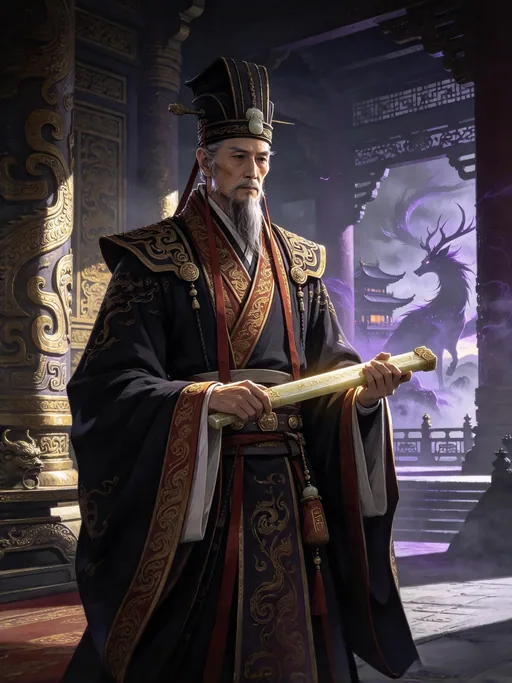
Bi Gan
MORTAL HEROES
比干
The youngest of the Sanxiao Sisters, a fiercely devoted and impulsive immortal who helped unleash the Nine-Meander Yellow River Formation, only to meet a tragic end at the hands of the supreme saints.
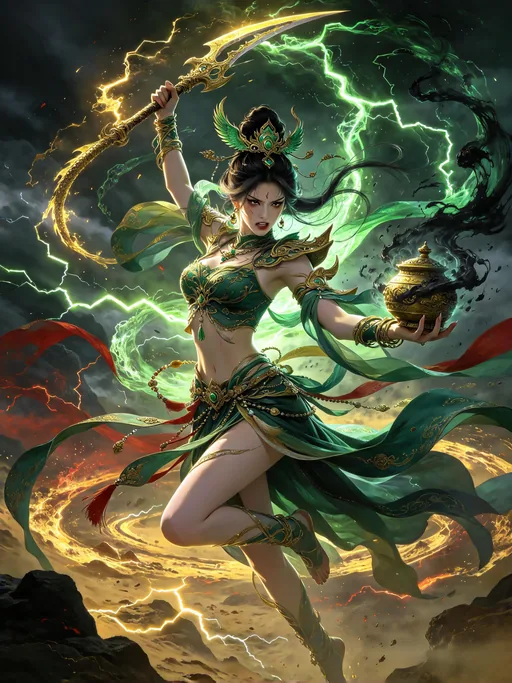
Bixiao Niangniang
IMMORTALS
碧霄娘娘
A beautiful maiden possessed by a thousand-year-old nine-tailed fox, sent by the goddess Nüwa to corrupt the Shang dynasty, only to be executed for her excessive cruelty.
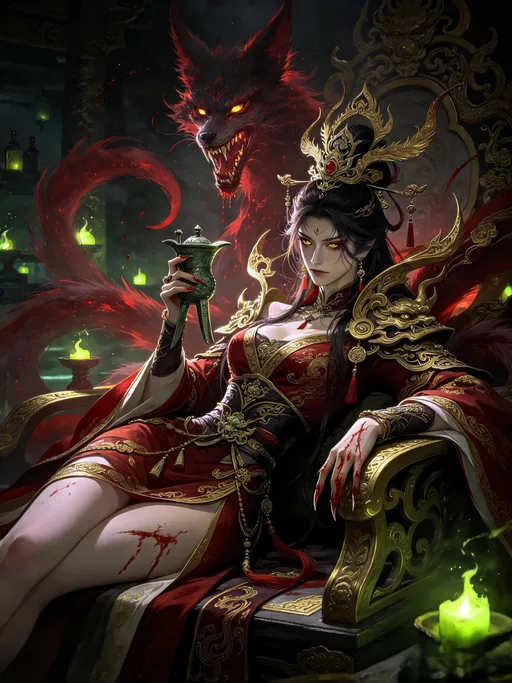
Da Ji
DEMONS
妲己
Deng Jiugong's daughter, a mortal general whose stones never miss a face. She wounded three Zhou champions and hit Kong Xuan three times when no immortal could touch him. Taken by a rope and married the same night to secure her father's defection, she fought for the Zhou until Gao Lanying blinded her with needles and cut her down. Enrolled as the Star of Six Harmonies.
Deng Chanyu
MORTAL HEROES
邓婵玉