Randeng Daoren
燃灯道人Dipamkara Daoist · The Lamp-Bearing Daoist
Vice-Leader of the Chan Teaching
The vice-leader of the Chan Teaching, an elder immortal who directs the breaking of the Ten Absolute Formations, loses and later gains the Twenty-Four Sea-Suppressing Pearls, and ends his career in the Western Teaching as the Lamp-Bearing Buddha.
Illumination of formations and the transmission of the lamp

Identity and Origins
Randeng Daoren is the vice-leader of the Chan Teaching and the senior immortal of Lingjiu Mountain's Yuanjue Cave. He is not one of Yuanshi Tianzun's twelve direct disciples; he stands above them as an elder brother in the dharma, the one the Twelve Golden Immortals call "teacher" when formations must be judged rather than merely fought. His name, "Randeng," means "Lamp-Bearing," and the novel uses it as more than a title. He is the figure who carries light into the dark places of the Investiture War.
This identity already contains his future. In Chinese Buddhist tradition, Dipamkara is the Buddha of the Past who predicts the enlightenment of the young Shakyamuni. The Fengshen Yanyi takes that name and gives it to a Daoist immortal who presides over a Daoist war, then sends him west at the end of the story. Randeng is therefore a bridge figure from his first appearance: a Daoist elder whose name is a Buddhist prophecy.
Appearance and Iconography
Randeng is usually depicted as an elderly or late-middle-aged Daoist, with a long beard, a high Daoist crown, and layered robes in sober colors. He rides a white deer, a mount that signals both purity and seniority. In his hand he carries the Qiankun Ruler, a measuring rod that is also a weapon — an object that suits a figure whose authority lies in judgment and measurement rather than raw force. He also possesses a purple-gold alms bowl, a Buddhist object that sits oddly and tellingly among his Daoist gear.
His most famous treasures are the Twenty-Four Sea-Suppressing Pearls. These are not originally his. They belong to Zhao Gongming, the Jie faction immortal, and they pass to Randeng only after a complicated defeat and exchange. Once in his hands, the pearls become his signature: twenty-four luminous spheres that can strike with the weight of the sea and, in later Buddhist reading, correspond to the twenty-four heavens. His iconography is thus split between Daoist rod and Buddhist bowl, between a deer and a string of pearls — a visual record of a career that crosses traditions.
The Ten Absolute Formations
Randeng's first major role in the Investiture War is not as a fighter but as a presiding strategist. When the Jie faction deploys the Ten Absolute Formations, the Chan side needs someone who can read each formation, assign the right breaker, and accept the cost. Randeng takes that role. He reviews the formations one by one, sends disciples and allies into them, and presides over a sequence of costly breakthroughs. Some of those sent in do not come back.
This is the moral texture of Randeng's authority. He is not a general who wins by refusing losses; he is the elder who decides which loss is acceptable. The novel does not sentimentalize this. Randeng's calm is the calm of someone who has already counted the cost and decided that the formation must fall. It is also why he is a natural counterpart to Jiang Ziya: Jiang Ziya carries the mandate and the roster, while Randeng carries the judgment of how to spend lives against a formation that is designed to consume them.
Zhao Gongming and the Sea-Suppressing Pearls
The Zhao Gongming episode is the hinge of Randeng's career. Zhao Gongming, riding his black tiger and wielding his iron whip, defeats several Chan immortals in succession. Randeng confronts him and is forced to retreat; the encounter exposes the limit of the vice-leader's authority when faced with raw, accumulated treasure-power. The Twenty-Four Sea-Suppressing Pearls in Zhao Gongming's hands are not merely weapons but a concentrated mass of cosmic water and light, and Randeng cannot simply out-judge them.
The pearls then change hands through the intervention of the scattered immortals Xiao Sheng and Cao Bao, whose Coins of Fallen Treasure strip Zhao Gongming of his treasures. Those pearls are later given to Randeng. The transfer is not a clean victory. It is a redistribution of cosmic capital during a war that is already redistributing everything. Once Randeng holds the pearls, his silhouette changes: the lamp-bearing elder now carries the sea in twenty-four spheres. In later Buddhist iconography, those spheres are read as the twenty-four heavens, and Randeng's Daoist treasure becomes the material of his Buddhist future.
The Ten Thousand Immortals Formation and the Western Turn
At the Ten Thousand Immortals Formation, Randeng fights alongside Laozi, Yuanshi Tianzun, and the two Western lords, Jie Yin Daoren and Zhunti Daoren. The formation is the war's final and largest convergence, and Randeng's role in it is consistent with his earlier career: he judges, strikes at the decisive point, and does not linger to claim the field. In the novel's account, he uses the Sea-Suppressing Pearls against Jie faction immortals, and the pearls' weight is finally turned against the tradition that first forged them.
After the formation breaks, Randeng does not remain in the Central Plains to receive a title or a territory. He goes west. This is the decisive difference between him and the gods who are enrolled on the Fengshen roster. His apotheosis is not a judgment passed on him; it is a transfer. The vice-leader of the Chan Teaching becomes the Lamp-Bearing Buddha of the Western Teaching, and the lamp that gave him his name becomes the lamp of a transmitted lineage rather than a battlefield signal.
Fate and Apotheosis
Randeng Daoren does not appear on the Fengshen roster. He is not killed, judged, and enrolled among the 365 gods. Like Jie Yin Daoren and Zhunti Daoren, he belongs to a class of figures who participate in the Investiture without being subject to its machinery. His end is a departure rather than a death: he returns west and is identified in later tradition with Dipamkara, the Lamp-Bearing Buddha, the Buddha of the Past who predicts Shakyamuni's enlightenment.
This outcome makes him one of the novel's clearest examples of how the Fengshen Yanyi absorbs Buddhist material without simply replacing Daoist material. Randeng is not a Daoist who "converts" in a dramatic scene. He is a figure whose name, treasures, and final destination were already Buddhist in implication, and the war merely brings that implication to the surface. His apotheosis is therefore less a reward than a disclosure: the lamp was always pointing west.
Cultural Legacy
Randeng's legacy is the legacy of a name that travels. In Ming vernacular fiction he is a Daoist vice-leader with a ruler, a deer, and a string of sea-heavy pearls. In Buddhist tradition he is Dipamkara, the Buddha of the Past, whose prediction sets Shakyamuni on the path. The Fengshen Yanyi does not choose between these identities; it lets them coexist, and that coexistence is the point.
For modern readers, Randeng is also a useful corrective to the idea that the Fengshen cast is divided cleanly into "good" and "evil" factions. He is an ally of the Chan side, but his methods are calculating and his final loyalty is elsewhere. He is a mentor who sends others into formations, a strategist who accepts losses, and a figure whose most famous treasure is taken from an enemy and then carried into a third tradition. He is, in short, a character made of transfers — and that is why he remains one of the most structurally interesting figures in the Investiture narrative.
More from this collection
A Shang grand counselor and royal uncle of King Zhou, killed on Daji's demand for his seven-orifice heart. His death became one of the dynasty's defining crimes, and he was apotheosized as the Lord of the Wenqu Star.
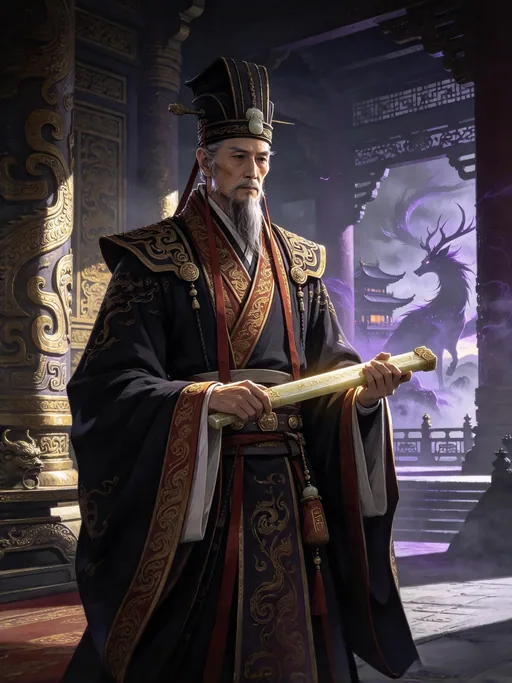
Bi Gan
MORTAL HEROES
比干
The youngest of the Sanxiao Sisters, a fiercely devoted and impulsive immortal who helped unleash the Nine-Meander Yellow River Formation, only to meet a tragic end at the hands of the supreme saints.
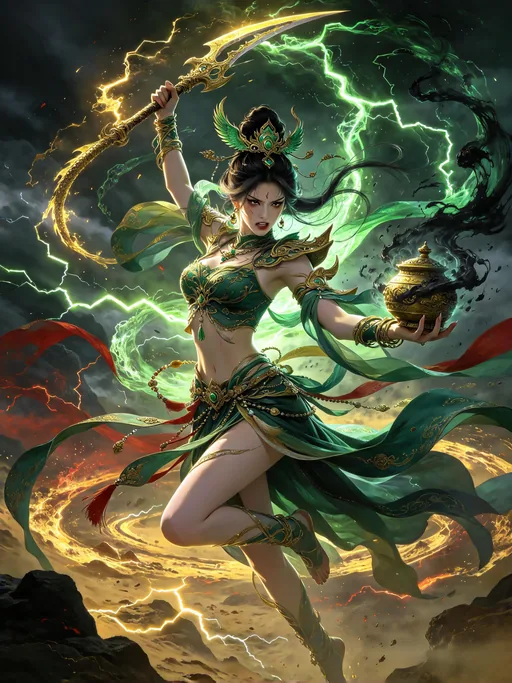
Bixiao Niangniang
IMMORTALS
碧霄娘娘
A beautiful maiden possessed by a thousand-year-old nine-tailed fox, sent by the goddess Nüwa to corrupt the Shang dynasty, only to be executed for her excessive cruelty.
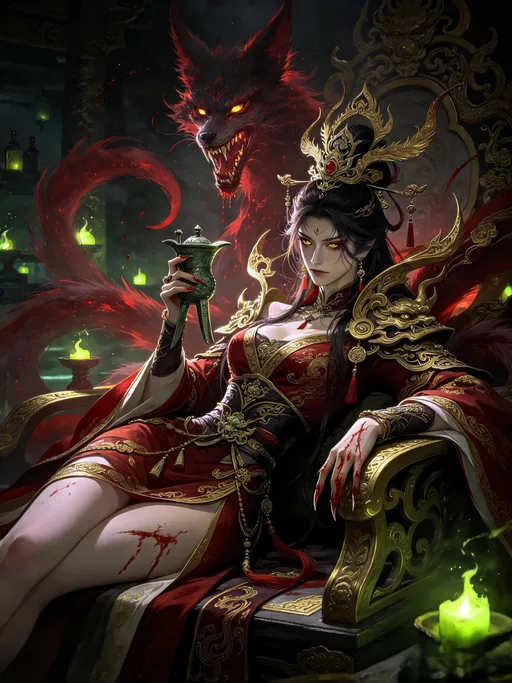
Da Ji
DEMONS
妲己
Deng Jiugong's daughter, a mortal general whose stones never miss a face. She wounded three Zhou champions and hit Kong Xuan three times when no immortal could touch him. Taken by a rope and married the same night to secure her father's defection, she fought for the Zhou until Gao Lanying blinded her with needles and cut her down. Enrolled as the Star of Six Harmonies.

Deng Chanyu
MORTAL HEROES
邓婵玉