Ju Liusun
惧留孙Chü Liu-sun · The Master of the Immortal-Binding Rope
Chan elder of Mount Jialong, who bound his enemies and never killed them
One of the twelve Chan elders of Kunlun, teacher of Tu Xing Sun, and the only one of the twelve who goes to war to arrest people rather than kill them. A patient ambusher who never duels, a diviner accurate enough to be cruel, and an elder whose plan to dispose of an unkillable enemy handed that enemy the weapon he came back with.
Capture rather than killing, the immortal-binding rope, and a divination that could name a disciple's death and not prevent it
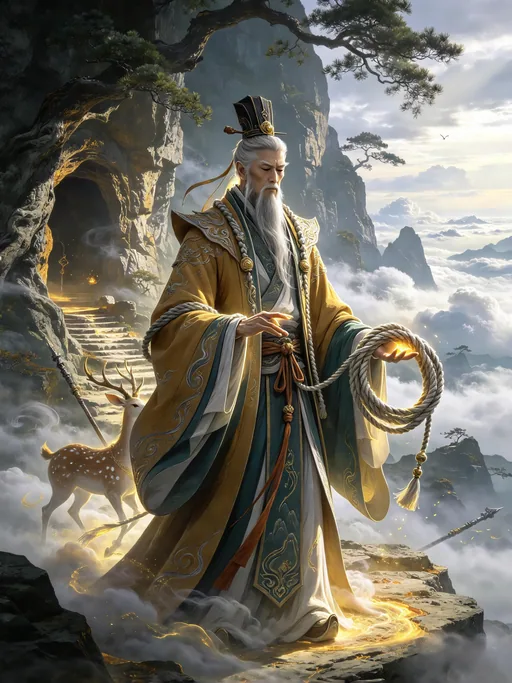
Identity and Place
Ju Liusun is one of the twelve Chan elders of Kunlun, a disciple of Yuanshi Tianzun, with his own cave on Mount Jialong. He is neither the strongest of the twelve nor the most prominent: no famous duel, no set-piece victory. What he has is a method, applied without exception, and a position — he is the elder called for when someone needs to be taken alive. The text is careless even about his mountain, naming the Flying Dragon Cave in four chapters and the Flying Cloud Cave in a fifth; he keeps no mount and walks into the formations on foot.
His name is the real curiosity: 惧留孙 transliterates Kanakamuni, one of the seven Buddhas of the past. The novel takes an Indian Buddha, keeps him as a Kunlun elder for eighty chapters, and sends him back — its largest act of religious transfer.
A Method, and One Broken Plan
His signature is not a weapon but a restraint. The rope flies out on its own, finds its target, ties him, and will not open for anyone lacking the spell. He uses it for everything and kills with none of it. This is rarer than it sounds: entry into the Ten Formations requires a slaughter-vow, and the elder who breaks one usually must announce that he is opening it before taking a head. Ju Liusun breaks the Earth-Fire Formation and takes its master alive, and the text sends him back to camp walking slowly — four characters no one else in the sequence receives. Not squeamishness, and the novel never calls it mercy. It is his method, and it holds to the last chapter.
The earth-compelling is the rope's partner — a pointed finger, and the ground is harder than iron; it serves one purpose, and he alone has it. His habits follow the same economy: he secures himself before acting, is never the man in front, and wins by ambush from where the enemy has no reason to look. His one failure is that instinct aimed at the wrong problem. He works out that Yu Yuan cannot be killed at all, and so proposes not an execution but a disposal — an iron cabinet sunk in the sea. Sound reasoning, disastrous outcome: iron in water feeds the element that governs water-escape, and the enemy rides the cabinet home and returns with a weapon built to pierce hearts.
The Disciple He Prepared For
He taught Tu Xing Sun to move through earth, and kept the one method that could stop a man moving through earth — the novel presents this not as treachery but as the reason the boy is still alive. When the disciple steals the rope and two gourds of elixir and goes down the mountain to serve the Shang, the master's first reaction is not anger but the discovery that he had never once checked the cave: the rope had been gone a long time and he had not noticed. He does not come down to fight; he comes down to collect. He lets the boy exhaust the rope against a target who is not there, then points, and the ground closes; then he takes him by the crown of the head and carries him back into the city — a master's grip, and not a gentle one, the grip for carrying something that must not touch ground.
What follows is the darkest thing in his story, done in the kindest vocabulary in the book. The boy is under sentence; Jiang Ziya wants his head; Marshal Deng has a daughter and a losing war. Ju Liusun casts a hexagram and reports that the two are bound by a fate fixed in a former life, and that if the girl comes over her father will follow. Nothing contradicts him and nothing supports him — except that the second half comes true, soon. So the hexagram was accurate. Whether an accurate hexagram is a just one is the question the novel leaves open; but it is worth seeing the room plainly. Everyone present needed that marriage. He is the only one who needed nothing from it, and he is the one who supplied the word "fate."
The Cliff He Named
When Mianchi will not fall he does not come himself. He sends a boy with a letter, and the letter opens by naming the cliff where his disciple will be killed, and saying that since the number could not be escaped there was nothing for him to do but weep toward it. He knows the place by name, six chapters early, and he does not go. The novel does not soften this with a scene of him trying and failing. He simply does not go, and gives his reason plainly.
Then, in the same letter, he takes the city. What follows is a complete operations order: who holds the riverbank with his talisman, who drives the quarry toward it, who takes the wall, how Jiang Ziya is to work the lure. Mianchi falls to a letter and he never leaves his cave. There is a symmetry the novel does not underline. The earth-compelling was the method he withheld from his own student, used once to press that student out of the ground and carry him home alive; burned on a riverbank, the same talisman locks the ground around the man who killed him. His enemy travels faster underground than the boy ever did, and the answer is not to travel faster — it is to make the ground stop being ground. Even in vengeance he will not compete on the enemy's terms.
West, and What He Became
At the Ten Thousand Immortals Array he meets an enemy he cannot handle, declines to risk a treasure he does not recognise, and runs west. The narrative stops there to say where he is running to, and the placement is the cruellest touch in his file: the most explicit statement in the novel about where one of the twelve ends up is inserted not at a triumph but in the middle of a rout. The direction of his flight is the direction of his future.
Then the West arrives in person, stops his pursuer, and grinds her down to her original shape. Ju Liusun lifts his sword to finish her — and is stopped, by the teaching he has not yet joined, with the words that he must not kill her, because the thought would leave the kalpa unfinished and the repayment unending. It is the only time anyone tells him not to kill, and he is in the act of doing it. The elder who spent eighty chapters taking prisoners reaches for a blade exactly once, over an enemy who has just beaten him and is no longer in human form. The first lesson of his new faith is somebody holding his hand.
More from this collection
A Shang grand counselor and royal uncle of King Zhou, killed on Daji's demand for his seven-orifice heart. His death became one of the dynasty's defining crimes, and he was apotheosized as the Lord of the Wenqu Star.
Bi Gan
MORTAL HEROES
比干
The youngest of the Sanxiao Sisters, a fiercely devoted and impulsive immortal who helped unleash the Nine-Meander Yellow River Formation, only to meet a tragic end at the hands of the supreme saints.
Bixiao Niangniang
IMMORTALS
碧霄娘娘
A beautiful maiden possessed by a thousand-year-old nine-tailed fox, sent by the goddess Nüwa to corrupt the Shang dynasty, only to be executed for her excessive cruelty.
Da Ji
DEMONS
妲己
Deng Jiugong's daughter, a mortal general whose stones never miss a face. She wounded three Zhou champions and hit Kong Xuan three times when no immortal could touch him. Taken by a rope and married the same night to secure her father's defection, she fought for the Zhou until Gao Lanying blinded her with needles and cut her down. Enrolled as the Star of Six Harmonies.
Deng Chanyu
MORTAL HEROES
邓婵玉